

Every professional now has access to more output. The scarce resource is judgment.
GPT-6 Astra sharpens that reality. OpenAI describes Astra as its most capable model for demanding end-to-end work, with strengths in complex reasoning, computer use, browsing, software engineering, research, science, and professional work. It can operate across files, code, browsers, and supported professional tools and can produce reviewable documents, spreadsheets, presentations, websites, and other finished artifacts through ChatGPT Work. Official Astra guidance | Official ChatGPT Work overview
That capacity will reward a different kind of professional. Speed with a blank page becomes less distinctive. The ability to frame the right problem, select trustworthy evidence, define authority, direct a complex workflow, recognize a subtle error, and communicate a consequential decision becomes more valuable.
These capabilities belong to what I call Professional Intelligence: the integrated capacity to understand work, people, systems, strategy, communication, emotion, influence, and execution. Astra increases the reach of that intelligence. It also exposes every weakness in it.
AI fluency is becoming a management capability
Most early AI training focused on prompts. Prompting still matters, although the business challenge has expanded. Professionals now need to design the conditions under which an intelligent system can work responsibly.
Astra responds to longer instructions and can remain coherent across sustained tasks. It can use tools, incorporate new requirements, ask focused questions when a decision could change the outcome, and check its work. Through skills and plugins, it can reuse a defined process and reach approved business systems. Through long-running work and scheduled tasks, it can support objectives and recurring operations that extend beyond one response. Official Skills and Plugins guide | Official long-running work guide
The professional's role increasingly resembles the role of a strong manager:
- Establish the objective.
- Supply or identify the controlling evidence.
- Clarify constraints and decision rights.
- Match the task to the right model, tool, and environment.
- Review progress and redirect when conditions change.
- Test the deliverable against an explicit standard.
- Accept responsibility for the final decision.
This is why access alone creates little advantage. The same model can generate a generic memo for one person and coordinate a complete, evidence-based decision package for another. The difference comes from the human operating method.
The capabilities professionals are likely to overlook
Context can become organizational memory
OpenAI publishes a 1.05 million-token context window for Astra in the API, with a maximum output of 128,000 tokens. Those numbers are API specifications and may differ from the limits available in a particular ChatGPT Work session. Their strategic implication is clear: a model can reason over a much larger collection of relevant material when the environment supports it. Official Astra model specifications
For a leader, that material might include strategy, customer research, policies, performance data, meeting notes, prior decisions, financial models, and draft communications. For a career professional, it might include a career history, job targets, accomplishments, market research, interview notes, and networking records.
The professional still has to curate the memory. Old strategy decks, conflicting brand files, unsupported claims, and duplicate instructions create an expensive fog. Source governance becomes part of professional competence.
Steering can preserve momentum
ChatGPT Work allows a user to follow progress, answer questions, and change direction. Astra also supports a developer feature called mid-turn steering through the Responses API over WebSockets. A new requirement can be introduced while the response is running, and valid completed work can be preserved. Official mid-turn steering guide
This resembles real executive work. Priorities change. A client supplies a new document. A market event alters the analysis. A stakeholder rejects one assumption. Skilled professionals redirect the remaining work while protecting what still has value.
Skills can preserve the method behind excellence
A skill can contain instructions, resources, templates, examples, and workflow standards for a repeatable task. Once tested, it can help ChatGPT or Codex follow the same process each time. Plugins can add connected tools and current context. Official Skills and Plugins guide
This creates an opportunity for organizations to encode high-quality practice: how a manager prepares a performance conversation, how an executive team reviews a strategic initiative, how a coach prepares for a client session, how a recruiting team evaluates evidence, or how a communications team checks a public claim.
The skill should preserve the reasoning standard and the verification method. Automating surface style alone produces consistent mediocrity.
Scheduled work can create professional vigilance
ChatGPT scheduled tasks can run on a recurring basis and, on eligible plans, can respond to supported Gmail, Slack, or GitHub events. A skill can define the recurring process. Official scheduled tasks guide
Imagine an executive receiving a weekly decision brief that contains only meaningful changes, unresolved risks, blocked commitments, and upcoming choices. Imagine a job seeker receiving a verified target-market update rather than scrolling through hundreds of loosely relevant listings. Imagine a manager receiving a concise summary of open follow-ups across approved sources.
The quality comes from the filter. More alerts create more noise. Professional intelligence determines what deserves attention.
Finished artifacts can accelerate influence
ChatGPT Work can create documents, presentations, spreadsheets, PDFs, images, visualizations, websites, and applications. This allows one body of evidence to become an executive memo, a board presentation, a manager playbook, an employee guide, a workshop, and a public explanation. Official ChatGPT capability overview
Professional influence depends on translating the same truth for different audiences without distorting it. Astra can help with that translation. The human owner must protect factual consistency, tone, confidentiality, and the purpose of each artifact.
Professional Intelligence becomes the differentiator
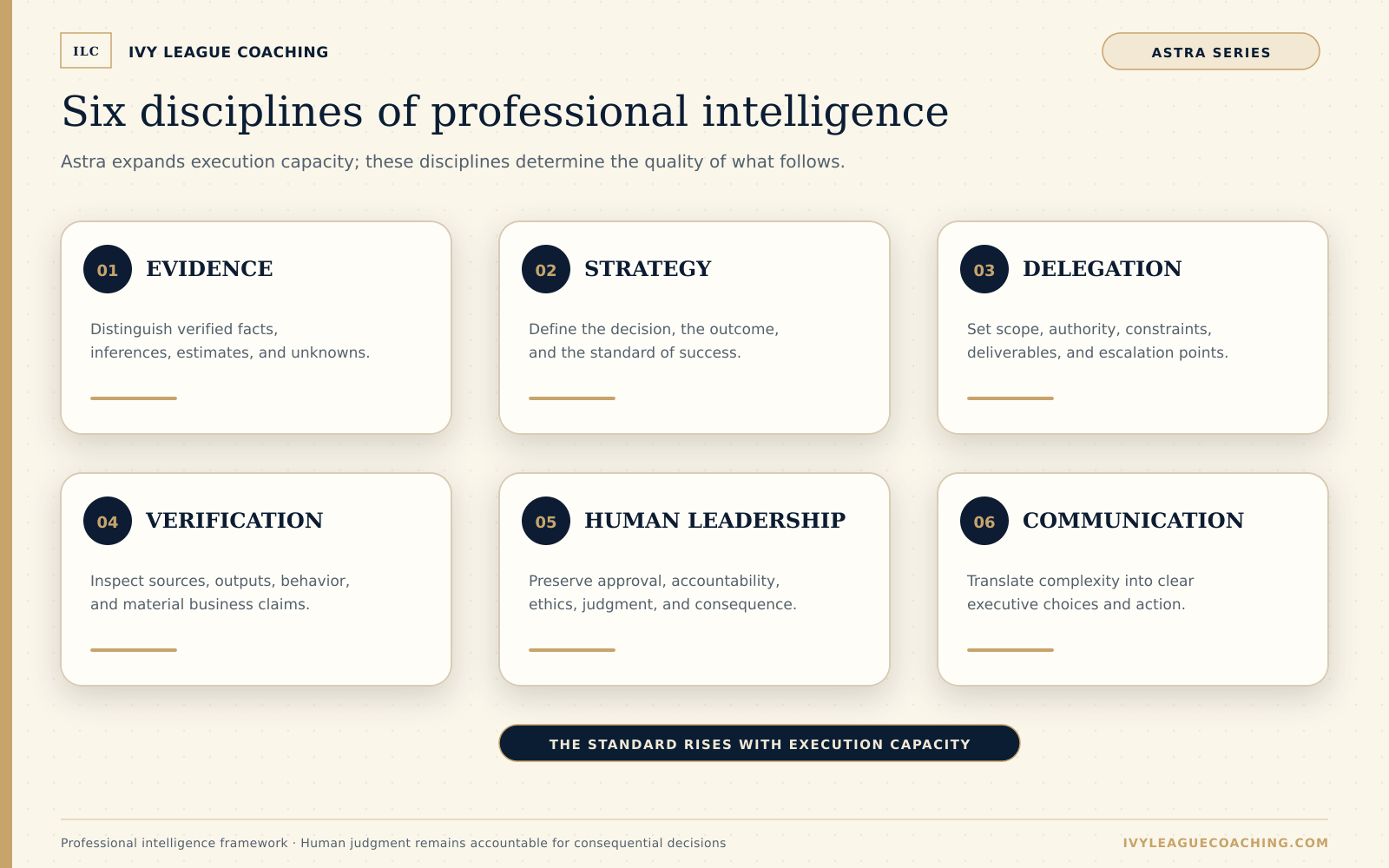
The workplace will increasingly reward six disciplines.
1. Evidence judgment
Professionals must know which sources are current, authoritative, complete, and relevant. They must distinguish verified facts from inference, estimates, untested workflows, and unknowns. Astra can follow that taxonomy when instructed. The human remains accountable for deciding whether the evidence is sufficient.
2. Strategic framing
A weak request asks for a report. A strategic work order explains which decision the report must support, which tradeoffs matter, what time horizon applies, and what would make the recommendation change.
3. Delegation architecture
Complex work should be divided into coherent workstreams with clear ownership and controlled write access. OpenAI's guidance recommends separate chats for independent long-running tasks and warns against allowing two tasks to change the same source at the same time. Official long-running work guide
4. Verification
A finished file is evidence of production. Verification establishes whether the file is accurate, complete, usable, and aligned with the source. Names, dates, numbers, links, citations, calculations, page layouts, and functional flows all require checks proportional to their importance.
5. Human leadership
People still need meaning, trust, fairness, courage, empathy, accountability, and a leader who understands the consequences of a decision. Astra can support preparation, pattern recognition, scenarios, and communication. It does not absorb moral or organizational responsibility.
6. Executive communication
Astra tends to produce detailed and formatted responses, according to OpenAI's own prompting guidance. Users should specify the audience, structure, language, and level of detail they need. A senior leader may need a one-page decision brief. A client may need a calm explanation. A team may need a concrete operating plan. Precision about communication is now part of AI direction. Official Astra prompting guidance
A new opportunity for leadership and career development
Organizations will need more than tool demonstrations. They will need role-specific operating practices.
Executives need to know where Astra can compress research and decision preparation, where confidential context may be used, and which decisions require explicit human review.
Managers need repeatable workflows for planning, meetings, performance conversations, operating reviews, project recovery, communication, and learning. They also need the confidence to challenge a polished output.
Professionals need career strategies built around augmented performance: the problems they can solve, the systems they can direct, the judgment they bring, and the evidence that shows their impact.
Coaches and learning leaders need to help people integrate AI with emotional intelligence, leadership, strategic thinking, communication, negotiation, and ethical responsibility.
This is an important business opportunity for Ivy League Coaching. Our work can help leaders and professionals develop the intelligence surrounding the model: clarify the objective, structure the workflow, direct the system, evaluate the result, communicate the decision, and build the human capabilities that technology amplifies.
A practical Astra protocol for professionals
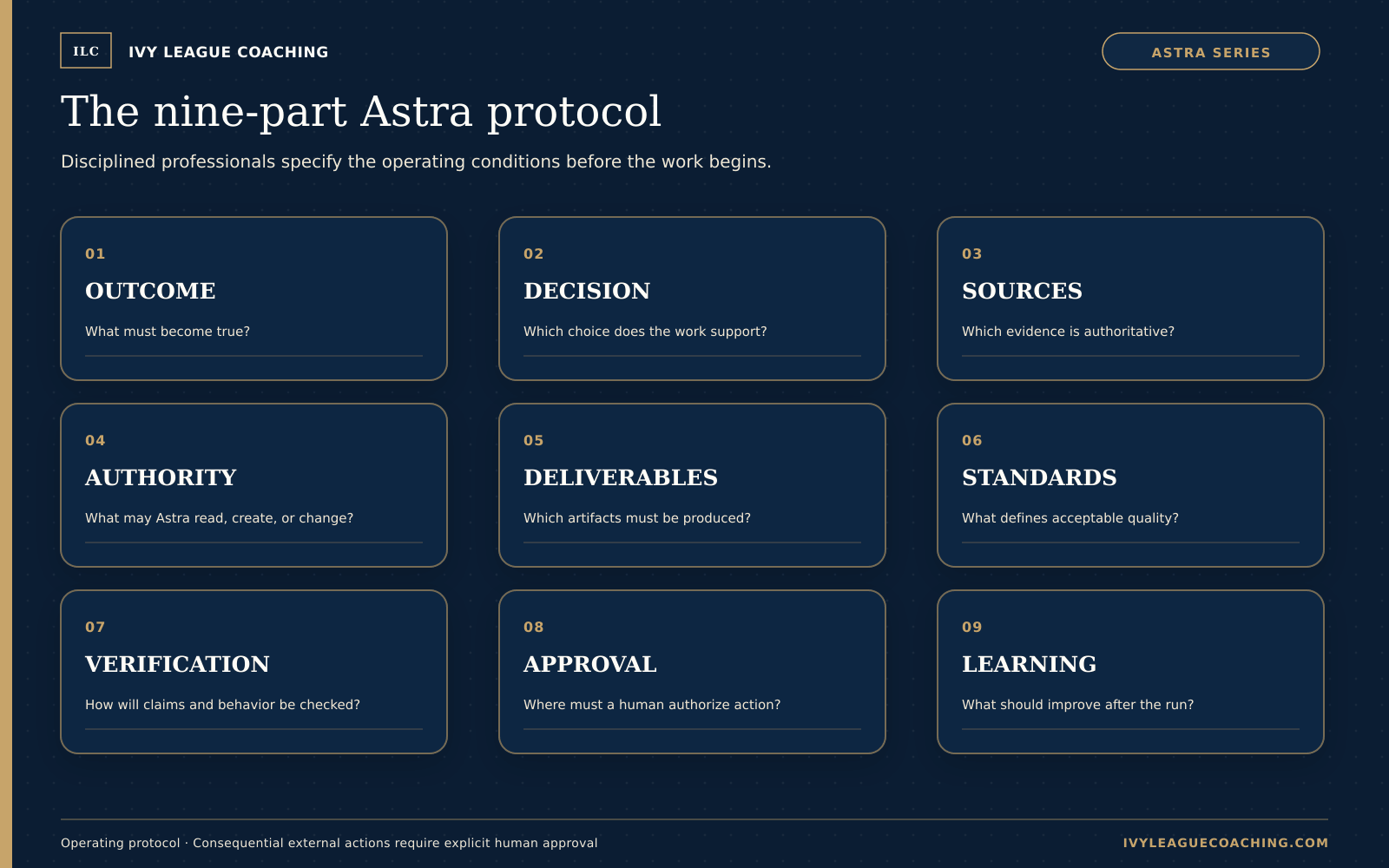
Before starting consequential work, define nine elements:
- Outcome: What completed result should exist?
- Decision: What choice, action, or business result will the work support?
- Sources: Which files, systems, people, and dates control?
- Authority: What may Astra read, draft, change, test, send, or publish?
- Deliverables: Which specific artifacts or implemented changes are required?
- Standards: Which brand, professional, legal, technical, or accessibility requirements apply?
- Verification: What evidence proves completion?
- Approval: Which consequential actions remain with a human?
- Learning: Which successful workflow should become a reusable skill?
That protocol creates clarity before speed. It also makes the professional's value visible.
The future of work will expose the quality of our thinking
Astra can increase the amount of work one person can direct. It can expand the range of artifacts that a small team can produce. It can preserve context across a more ambitious objective and connect analysis to approved tools.
The result will magnify whatever surrounds it. Clear strategy gains reach. Strong standards gain consistency. Weak evidence spreads faster. Confused authority produces more sophisticated chaos.
Professional Intelligence is the capacity to direct that power toward sound decisions and responsible results. The next career advantage will belong to people who can think across the whole system, lead human beings through change, and verify that the work deserves to be trusted.
Author note
Keith Lawrence Miller, M.A., is an organizational and business psychology practitioner, executive coach, author, and founder of Ivy League Coaching and MyTopMatch. His work focuses on Professional Intelligence, leadership, management capacity, career strategy, and the changing relationship between human judgment and technology.
Capability disclosure
The author received access to GPT-6 Astra in ChatGPT on September 5, 2026. Product capabilities cited here come from official OpenAI documentation reviewed on the same date. The leadership, career, and business implications are the author's analysis. Availability and limits vary by plan and environment.
THE ASTRA SERIES
Advanced capability needs an operating standard.
This essay is the Professional Intelligence lens in a three-part series on putting Astra to work.