

Founder commentary · LinkedIn Strategy
You Pay for LinkedIn. Sellers Pay to Reach You. You Pay Again With Your Attention.
LinkedIn calls it professional networking. Too often, it feels like a monetized system of unwanted access.
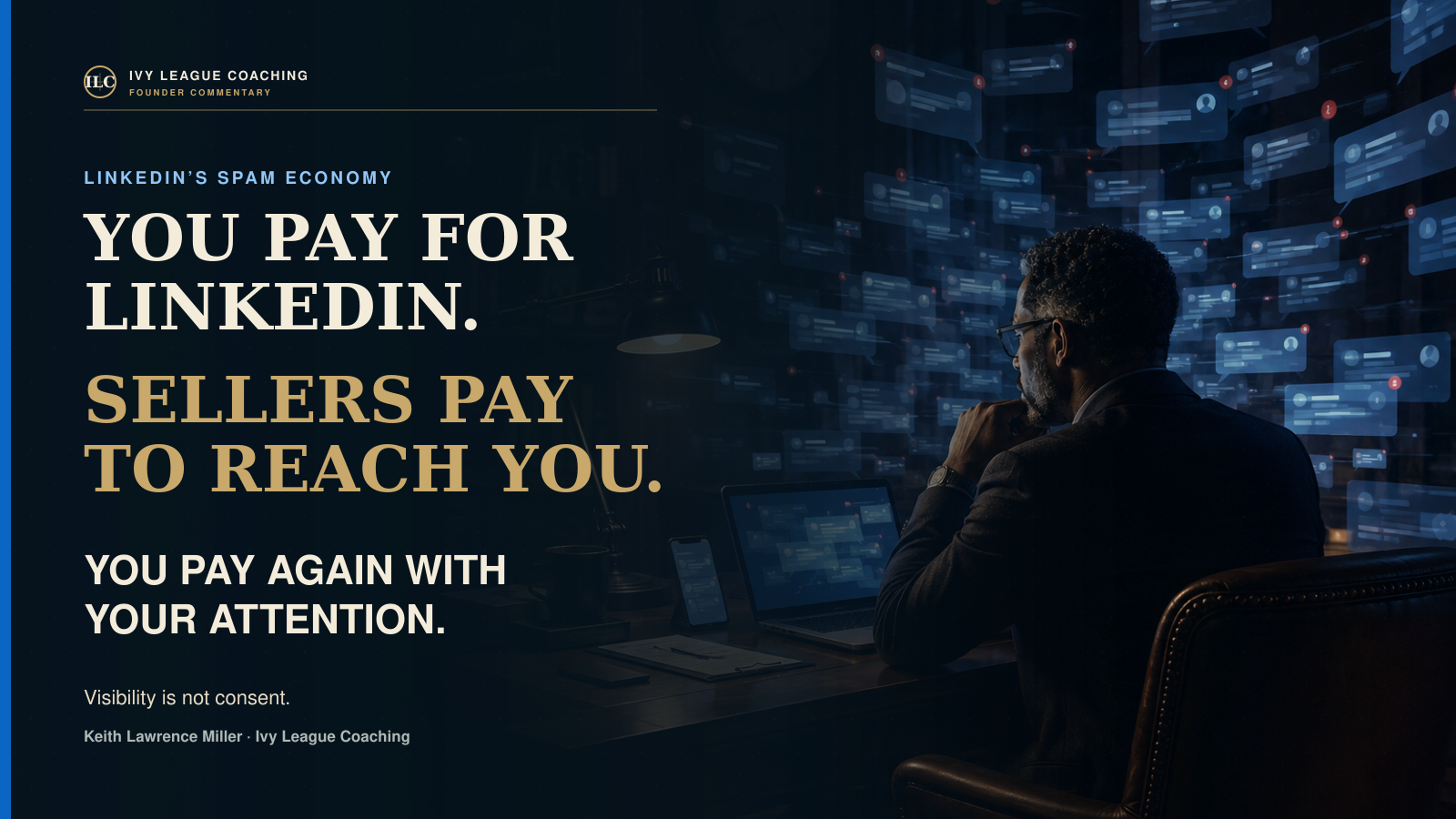
My email does not simply receive LinkedIn-related sales spam. It gets hunted by it.
Every five or ten minutes, another message arrives.
“Quick question.”
“I came across your profile.”
“I noticed what you are doing at Ivy League Coaching.”
“We help companies just like yours.”
“Do you have fifteen minutes this week?”
The service changes. The script barely does.
One person wants to rebuild a system I did not ask them to review. Another wants to generate leads I did not ask them to find. Another wants to improve a process they have never seen. Someone wants to discuss software I do not need. Someone else wants to schedule a call to explain why I should need it.
It happens during the workday. It happens at dinner. It happens throughout the night. I wake up and find twelve or more new messages from strangers, each attempting to manufacture urgency, familiarity, or obligation.
This is not a rare inconvenience. It is a repeated condition of using the modern professional internet.
And LinkedIn is not merely standing nearby while it happens.
LinkedIn has built, promoted, and monetized much of the infrastructure that makes professional attention available for purchase.
The member may pay for Premium. The seller may pay for Sales Navigator, Premium Business, Recruiter, or another prospecting capability. LinkedIn gets paid on multiple sides of the interaction.
The person being interrupted receives the bill in a different currency:
- time;
- focus;
- cognitive load;
- irritation;
- inbox disorder;
- sleep disruption;
- and the growing feeling that being professionally visible means consenting to be continuously pursued.
I did not consent to that bargain.
Let Us Call It What It Is
I run businesses. I sell professional services. I understand marketing, business development, and the need to create opportunity.
This is not an argument against selling.
It is an argument against pretending that industrialized interruption is relationship-building.
A real professional conversation begins with relevance, judgment, timing, and some reasonable basis for believing the other person may want the exchange.
Spam begins with the sender’s objective.
The recipient is treated as a conversion opportunity before being treated as a person.
That is why so many of these messages feel strangely identical even when a first name, company name, or recent post has been inserted. The personalization is cosmetic. The underlying act is mass prospecting.
If the same message could be sent to five hundred people after changing three fields, it is not personal. It is a template wearing a name tag.
The language is designed to lower resistance:
- “Just reaching out” makes the interruption sound neutral.
- “Quick question” hides the fact that the sender wants time, money, or access.
- “I thought this might be relevant” transfers the burden of qualification to the recipient.
- “Not sure if you are the right person” asks the target to complete the sender’s research.
- “Can I send more information?” attempts to convert silence into a pending conversation.
- “Worth a chat?” compresses a sales agenda into four harmless-looking words.
These are not always dishonest messages. Some represent legitimate businesses and capable people.
But legitimacy does not create consent.
The fact that someone can help does not mean I requested help. The fact that someone found my professional profile does not mean I volunteered to enter that person’s sales funnel. The fact that my work is public does not make my attention public property.
The Business Model Is Hiding in Plain Sight
LinkedIn’s own documentation makes the structure clear.
LinkedIn describes InMail as a Premium feature that allows a paying user to message a member with whom they are not connected. Sales Navigator users are allocated 50 InMail credits each month, specifically to engage potential leads and facilitate sales conversations.
This is not a side effect of the product. Prospecting access is one of the products.
In 2024, Microsoft described Sales Navigator as a business generating more than $1 billion. It explained the product in straightforward terms: Sales Navigator helps sellers understand potential customers, determine whom to contact, and identify what is happening inside target companies. That is a legitimate commercial capability. It is also direct evidence that professional access, intelligence, and outreach are monetized at enormous scale.
The economic arrangement looks like this:
- Professionals create profiles containing their roles, employers, accomplishments, interests, location, education, network, activity, and career movement.
- That collective activity makes LinkedIn extraordinarily valuable as a professional-data and relationship platform.
- LinkedIn sells premium tools that help other people search, classify, monitor, prioritize, and contact members.
- The recipient must manage the resulting stream of approaches—whether or not the recipient wanted to become a lead.
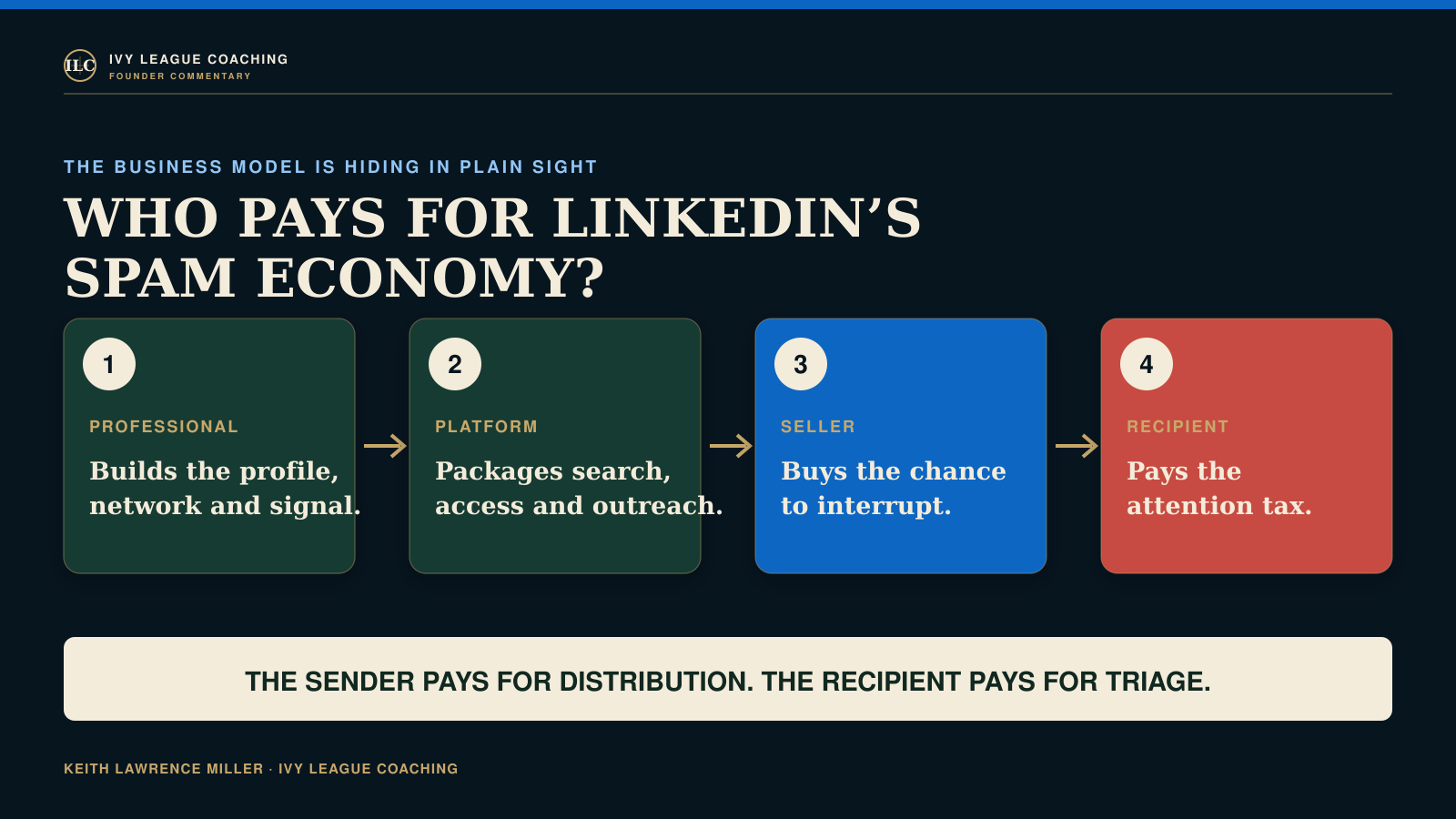
The professional builds the signal.
The platform packages the access.
The seller buys the opportunity to interrupt.
The recipient absorbs the consequence.
That is the attention economy in professional clothing.
There Are Two Different Spam Problems—and They Should Not Be Confused
Accuracy matters here.
One category is LinkedIn-native contact: InMail, connection requests, direct messages, service requests, and the email notifications generated by those activities.
The second category is external cold email sent by someone who identified a person through LinkedIn but obtained or inferred the email address elsewhere—through a public website, contact database, enrichment service, previous data exposure, a guessed company-email pattern, or another source.
The fact that a cold email references a LinkedIn profile does not prove that LinkedIn directly gave or sold the sender the recipient’s email address. LinkedIn states in its current California privacy disclosure that it does not sell personal information.
I am not claiming that LinkedIn sold my email address to every person who appears in my inbox.
I am making a different argument.
LinkedIn has become the central identification, targeting, and credibility layer for a much larger outreach industry. It trains sellers to view professionals as searchable leads, sells tools for finding and contacting prospects inside the platform, and exists alongside an enormous third-party ecosystem built to move that prospecting into email, automation, enrichment, sequencing, and repeated follow-up.
LinkedIn may not have sent every email.
The LinkedIn-centered prospecting economy still helped create the target.
The Recipient Is Not the Customer in That Moment. The Recipient Is the Inventory.
This is the part the professional-networking narrative avoids.
When a seller pays for tools that help identify and reach me, the tool is serving the seller. My profile, role, company, activity, and possible needs become inputs into the seller’s workflow.
I may also be a paying LinkedIn customer.
That creates a remarkable double relationship.
I pay LinkedIn for professional value. Someone else pays LinkedIn for improved access to people like me. Then I must spend my time separating legitimate relationships and meaningful opportunities from sales approaches I never requested.
In that moment, my attention has effectively become inventory.
This is why “just ignore it” is not a serious answer.
Ignoring one message takes almost no time. Ignoring hundreds requires a system.
Each message must be noticed before it can be dismissed. A subject line enters awareness. A notification interrupts the screen. A name has to be recognized or ruled out. A message has to be distinguished from a client, colleague, media inquiry, professional opportunity, or actual relationship.
Spam extracts a micro-decision.
At scale, those micro-decisions become an attention tax.
The sender pays for distribution.
The recipient pays for triage.
“No Thanks” Can Still Reward the System
There is another revealing detail in LinkedIn’s model.
LinkedIn’s general InMail credit policy says that an InMail credit can be returned when a recipient accepts, declines, or responds within the specified period. Quick Replies also count as responses.
Think about what that means from the recipient’s perspective.
Even the act of rejecting the approach may help replenish the sender’s capacity to approach someone else.
The platform can interpret engagement as a healthy signal even when the human meaning of the engagement is: I do not want this.
That is a design problem.
A refusal should protect the recipient and inform sender quality. It should not merely become another event that helps sustain the outreach cycle.
The Service-Request System Creates a Different Kind of Waste
The seller side of LinkedIn produces another frustrating experience: service requests that look like qualified leads but often contain very little intent.
LinkedIn encourages professionals and companies to create Service Pages. Certain paid subscriptions receive enhanced service visibility and may qualify for additional requests. LinkedIn’s own help materials explain that when a potential client sends a request to a particular provider, the person may also choose to send that request to additional similar providers at the same time.
That distinction matters.
A provider can receive what appears to be a direct inquiry even though the requester may be exploring casually, distributing the request broadly, comparing many responses, or misunderstanding what will happen after submitting it.
LinkedIn explicitly states that submitting a proposal merely starts a conversation and does not guarantee a contract. That disclaimer is accurate, but it does not solve the underlying quality problem.
In my own experience as a provider, the overwhelming majority of these inquiries—roughly nine out of ten by my informal estimate, not a platform-wide measurement—have shown little or no meaningful purchase intent.
Some people appear to believe the support is free.
Some appear to believe it is included with their LinkedIn membership.
Some submit a request and never engage with the providers who respond.
Some may simply be clicking through a low-friction interface without realizing that multiple professionals will now spend time reviewing the request, preparing a response, and attempting to help.
The requester experiences a simple form.
The provider experiences a lead.
LinkedIn experiences activity on both sides.
But activity is not the same as intent.
When platforms measure successful interaction by submissions, responses, and conversations started, they can overproduce motion while underproducing value.
That is not merely inefficient. It teaches providers to distrust the platform’s own leads.
The Emotional Cost Is Real
The discussion around spam usually becomes technical very quickly.
Create a filter.
Turn off a notification.
Mark the sender.
Block the account.
Unsubscribe.
Report the message.
Those controls matter, but they frame the problem as inbox maintenance rather than repeated boundary violation.
When messages arrive every few minutes, at all hours, the experience changes.
You do not feel contacted. You feel pursued.
You do not feel professionally visible. You feel exposed.
You do not feel invited into a relevant conversation. You feel selected by a system that has decided your position, company, or public activity makes you worth repeatedly testing.
That experience is especially exhausting for business owners, executives, recruiters, advisors, and other professionals whose inboxes already contain legitimate time-sensitive demands. We cannot simply ignore every unfamiliar name. A new client, partner, journalist, candidate, or important opportunity may also arrive without a prior introduction.
Spam exploits that necessary openness.
It forces people to remain accessible while punishing them for being accessible.
LinkedIn’s Policy and Product Are in Tension
LinkedIn’s Professional Community Policies say the platform does not allow untargeted, irrelevant, obviously unwanted, unauthorized, inappropriate commercial or promotional, or gratuitously repetitive messages. The policies also instruct members not to use invitations to send promotional messages to people they do not know.
That is the correct standard.
The problem is that LinkedIn’s commercial products and growth logic continually push in the opposite direction.
Sales tools encourage more identification, more targeting, more outreach, more engagement, and more conversations. AI-assisted messaging reduces the effort required to produce language that appears personalized. Providers can pay for greater visibility and additional service-request opportunities. A recipient’s professional activity becomes a trigger for someone else’s sales sequence.
LinkedIn prohibits spam as a behavior while monetizing capabilities that make unsolicited access more scalable and attractive.
Those facts can coexist. LinkedIn can genuinely oppose abusive spam while legitimately selling prospecting tools.
But the conflict cannot be resolved by publishing rules alone.
If a platform profits when more people initiate commercial contact, it must build recipient protection into the economics and product design—not hide the entire burden inside settings, filters, and individual reports.
What LinkedIn Should Change
LinkedIn can preserve legitimate business development without treating every visible professional as an always-available lead.
1. Create a true “No Sales Prospecting” control
Members should be able to reject unsolicited product and service pitches without also blocking legitimate recruiter outreach, partnership discussions, client communication, or messages from professional contacts.
The current ability to disable InMail is too blunt. People should not have to close the entire door because salespeople refuse to stop crowding the entrance.
2. Make message intent mandatory
Before contacting someone outside their network, senders should classify the message:
- recruiting;
- sales;
- partnership;
- media;
- event;
- research;
- service inquiry;
- or other.
Recipients should be able to route, limit, or block each category independently.
Misclassification should affect sender privileges.
3. Build an actual commercial-message inbox
Sales messages should not merely be identified by weak filtering after they arrive. They should enter a dedicated commercial area by default unless the recipient has chosen otherwise.
If LinkedIn can help sellers identify highly specific prospects, it can identify obvious prospecting language.
4. Measure recipient burden, not only sender engagement
LinkedIn should track:
- repeated nonresponse;
- blocks;
- spam reports;
- fast deletions;
- “not relevant” selections;
- message similarity across recipients;
- excessive follow-up;
- and sender-level rejection patterns.
A seller generating widespread irritation should lose reach, even if the messages technically avoid prohibited words.
5. Stop rewarding rejection
A decline or “not interested” response should not function like positive engagement. Rejection should suppress future outreach from that sender and improve system-level protections for the recipient.
6. Put hard limits on repeated access to the same person
The system should recognize when one member is being approached by many sellers offering the same category of service. Recipient-level saturation limits would reduce the feeling of being hunted by interchangeable vendors.
7. Qualify service requests before distributing them
Someone submitting a service request should be required to indicate:
- whether they expect free or paid assistance;
- their approximate budget;
- their decision timeframe;
- whether the request will be sent to multiple providers;
- whether they are ready to speak;
- and what outcome they are actually seeking.
Providers should see that information before deciding whether to respond.
8. Tell requesters exactly what will happen
If a request will be shared with multiple providers, say so prominently before submission:
“Submitting this request may invite responses from several independent providers. Their services are not included with your LinkedIn membership, and each provider sets their own fees.”
That single disclosure would eliminate substantial confusion.
9. Give paying members stronger attention protections
A Premium subscription should not mean paying for better access to a network while remaining equally available as inventory for someone else’s premium prospecting subscription.
Paid members should receive advanced controls over who may contact them, why, how often, and where those messages appear.
What Sellers Need to Hear
Not every failure belongs to LinkedIn.
Sales professionals, founders, agencies, consultants, and automated-outreach operators make choices.
A quota is not consent.
A target profile is not an invitation.
A public job title is not evidence of need.
A funding announcement is not permission to flood a company’s leaders.
A recent post is not a meaningful relationship.
Adding a sentence about someone’s background does not transform mass outreach into personal outreach.
Before sending the message, ask:
- Is there credible evidence this person may need what I offer?
- Is the message specific enough that it could not sensibly be sent to hundreds of others?
- Have I explained why I selected this person—not merely why I want a meeting?
- Can the recipient understand the value without accepting a call?
- Have I made “no” easy and final?
- Would I consider this respectful if I received it at the same volume?
If the answer is no, the message is probably not networking.
It is prospecting debt transferred to a stranger.
Professional Networking Requires Mutuality
LinkedIn remains valuable. It connects professionals, creates visibility, helps people discover opportunities, supports recruiting, and gives individuals a public record of their work.
That value is exactly why this problem matters.
A professional network should not force members to choose between invisibility and continuous commercial interruption.
Networking requires some possibility of mutual value.
Selling requires judgment.
Access requires boundaries.
And visibility is not consent.
I did not join LinkedIn to become a recurring target for strangers running the same script through different accounts.
I did not pay for a professional membership so that other paying customers could treat my inbox as a sales territory.
I did not build a career, a business, a network, and a public professional identity so that every vendor with a sequencing tool could claim fifteen minutes of my life.
LinkedIn must decide what kind of platform it wants to be.
It can be a professional network that respects the people who create its value.
Or it can become a paid hunting preserve where one customer buys increasingly efficient access to another customer’s attention.
It cannot keep pretending those are the same thing.
Accuracy and Source Note
This article combines the author’s firsthand experience and opinion with descriptions of LinkedIn features documented by LinkedIn and Microsoft. The “roughly nine out of ten” service-request figure is an informal estimate based on the author’s own provider experience; it is not presented as LinkedIn-wide conversion data. The article does not claim that LinkedIn directly sold the author’s email address to external cold-email senders.
Sources reviewed August 28, 2026:
- LinkedIn Help, InMail Messages
- LinkedIn Help, Understand InMail Credits in Sales Navigator
- LinkedIn Help, InMail Message Credits and Renewal Process
- Microsoft Investor Relations, Bank of America Global Technology Conference, June 6, 2024
- LinkedIn Help, Stop Receiving Additional Service Requests
- LinkedIn Help, Respond to Requests for Your Services
- LinkedIn Help, Offer Services on LinkedIn With Your Personal Profile
- LinkedIn, Professional Community Policies
- LinkedIn, California Privacy Disclosure
- LinkedIn Help, Opt Out of Receiving InMail Messages
Shareable briefing
The argument, designed for discussion.
Download the companion 10-page document to share the central ideas: members create the signal, sellers buy access, and recipients absorb the attention tax.
Download LinkedIn BriefingProfessional positioning
Build a Professional Presence Without Becoming More Noise.
Ivy League Coaching develops evidence-based LinkedIn positioning and professional narratives designed for credibility, relevance, and real human judgment.