

Career Strategy
Why Experience Does Not Automatically Create Opportunity
The Career-Conversion Model explains why highly capable professionals get stuck—and what has to happen before ability becomes career mobility.
A professional can spend twenty years becoming very good at what they do and still discover, unexpectedly, that the market does not know what to do with them.
They may have been promoted repeatedly. Their employer may depend on them. Colleagues may respect their judgment. Their compensation may have climbed steadily. Their title may suggest authority and success.
Then something changes.
A restructuring eliminates the role. A new leader arrives. Technology changes the work. The professional wants to move into another industry. A promotion fails to materialize. Or the person simply decides that the current career no longer fits.
Suddenly, experience that felt enormously valuable inside one environment does not automatically translate into opportunity somewhere else.
That does not necessarily mean the person lacks capability.
It means capability and mobility are not the same thing.
That distinction sits at the center of The Mobility Advantage and what I call the Career-Conversion Model.
The question is simple:
What must happen before capability becomes movement?
The answer is a sequence:
Every stage matters. Every arrow is a conversion that can succeed—or break down.
The Career Ladder Was Never the Complete Map
For generations, the career ladder gave professionals an understandable picture of advancement.
- Learn.
- Perform.
- Gain experience.
- Receive the next title.
- Earn more.
- Move upward.
There is nothing inherently wrong with that model. Many organizations still have meaningful internal career structures.
The problem begins when advancement inside one institution is assumed to equal mobility outside it.
It does not.
A title tells us where someone currently stands.
Mobility tells us what credible options remain available from that position.
“Position describes where you stand. Mobility describes what credible options remain available from that position.
That difference can remain invisible for years.
Imagine a senior operations leader who has spent two decades inside one organization. He has survived reorganizations, led major initiatives, gained authority, and developed deep institutional knowledge.
Then his position disappears.
Externally, recruiters struggle to interpret the company's internal titles. Some of his strongest accomplishments depend on proprietary systems. Most of his professional network remains connected to the same employer. His compensation has risen beyond what comparable positions elsewhere may offer.
None of that erases his ability.
It reveals something different:
His professional value became heavily concentrated inside one system.
The manuscript uses precisely this type of composite situation to distinguish position from mobility: a career can rise for years without building the capacity to travel.
That is why experience alone does not create opportunity.
Experience still has to be converted.
A Career Is a System of Conversion
The Career-Conversion Model separates career mobility into seven connected stages.
1. Capability: What can you actually do?
Capability is the foundation.
It includes technical knowledge, transferable skills, contextual understanding, communication, judgment, and the ability to produce consequences that matter.
This sounds obvious, but modern career advice frequently begins too far downstream.
People are told to improve their résumés, expand their networks, optimize LinkedIn, interview more confidently, or strengthen their personal brands.
Those activities can matter.
But none permanently substitutes for the ability to create value.
A polished professional story may create access to a job. It cannot perform the job after arrival.
The relevant question is not simply:
What do you know?
It is:
What changes because you apply what you know?
- A strong communicator changes understanding.
- A strong operations leader improves reliability.
- A strong strategist changes priorities or resource allocation.
- A strong coach changes behavior.
- A strong risk professional prevents or reduces consequential failure.
The book makes this distinction explicit: professional capability becomes meaningful when it produces consequences, not merely when it can be described with attractive adjectives.
2. Evidence: Can you prove it?
Capability is private until it leaves a trace.
That trace is evidence.
Evidence may include:
- measurable outcomes;
- work samples;
- credentials;
- recommendations;
- publications;
- project results;
- formal evaluations;
- customer or stakeholder outcomes;
- independently verified performance.
This creates one of the most common career problems I have seen:
The person knows what they can do. The market does not.
The professional may have accumulated years of excellent performance without systematically documenting it.
Then, during a job search, they attempt to reconstruct a career from memory.
- What was the baseline?
- How much did performance improve?
- What was their individual contribution?
- Who can verify it?
- What happened afterward?
Details disappear surprisingly quickly.
That is why The Mobility Advantage recommends maintaining a Professional Evidence Bank before a transition becomes urgent.
The larger principle is even simpler:
Evidence beats adjectives.
Saying: “I am a strategic leader” is an assertion.
Explaining: “I identified a portfolio concentration problem, led the cross-functional decision process, and helped produce a documented improvement in margin” gives the audience something to evaluate.
The book's Evidence Ladder moves from assertion to activity, responsibility, output, outcome, independently validated outcome, and finally repeated outcomes across contexts.
This is where a résumé fits into career strategy.
A résumé is not the career.
It is one evidence-delivery mechanism inside a much larger conversion system.
3. Recognition: Does the right audience understand what the evidence means?
Evidence does not interpret itself.
This is where many highly qualified professionals become confused.
They possess legitimate experience.
They have results.
They may have respected credentials.
Yet the target audience does not assign the same meaning to those signals that the professional does.
A military leader may possess enormous operational responsibility but describe it using language unfamiliar to civilian employers.
A senior professional from a smaller organization may have much broader responsibilities than the title suggests.
A founder returning to corporate employment may have commercial judgment that does not map neatly onto conventional job titles.
An international professional may possess rigorous credentials that a local employer does not immediately recognize.
A professional moving between industries may discover that evidence valued strongly in one setting receives limited recognition in another.
The problem is no longer capability.
It is interpretation.
The manuscript makes this distinction directly: a credential, achievement, or signal has limited effect when the evaluator does not understand it, trust it, or see its relevance.
This is why career positioning matters.
Positioning does not manufacture value.
It makes real value understandable to a particular audience.
4. Access: Can your value reach the people and systems that control opportunity?
You can possess capability.
You can document it.
The market can even recognize it.
And you can still remain outside the rooms where opportunities are created.
That is an access problem.
Access includes:
- relationships;
- recruiters;
- alumni networks;
- professional associations;
- sponsors;
- decision-makers;
- institutional membership;
- developmental assignments;
- geography;
- technology;
- financial ability to participate.
The book distinguishes access from networking because the concepts are not interchangeable.
A person can have thousands of LinkedIn connections and very little meaningful access.
Another can maintain a relatively modest network but have relationships that transmit trusted information across organizations, industries, and decision levels.
Research summarized in the manuscript also supports the importance of relationship structure: moderately weak ties can carry nonredundant information into networks beyond someone's immediate circle.
But access is about more than who you know.
It is about what information, trust, and decision authority can move through those relationships.
A mentor can advise you.
A sponsor does something different.
A sponsor places credibility at risk on your behalf.
They mention your name when you are not in the room.
They recommend you for the assignment.
They explain why you are ready.
They convert recognition into access.
That is a fundamentally different career mechanism from collecting contacts.
5. Opportunity: Does a real opening actually exist?
This stage is surprisingly easy to overlook.
You can be extraordinarily capable.
You can have excellent evidence.
People can recognize your value.
You can reach decision-makers.
And there still may not be an opportunity.
A warm introduction cannot create budget.
Networking cannot manufacture demand.
A recruiter cannot create a position the employer has not approved.
A declining occupation does not become a growing one because the candidate improves their résumé.
This distinction matters because professionals frequently invest more effort into the wrong conversion stage.
Someone experiencing an Opportunity problem may respond by networking harder.
Someone with a Recognition problem may pursue another degree.
Someone with an Evidence problem may increase social-media activity.
Someone with a Capability problem may repeatedly revise their résumé.
The activity can be legitimate and still fail because it is aimed at the wrong bottleneck.
As the book puts it, generic career advice fails when it treats different conversion problems as interchangeable.
6. Choice: Can you actually act on the opportunity?
This may be the least conventional stage of the Career-Conversion Model.
It may also be one of the most important.
Career advice often treats an offer as success.
A person might receive an excellent offer that requires relocation while caring for an aging parent.
A parent may receive a promotion requiring travel incompatible with childcare.
A professional may rely upon health benefits unavailable from the new employer.
An international worker may depend upon a particular employment arrangement for work authorization.
“An opportunity is not automatically a choice.
A senior executive may be unable to absorb a major compensation reduction because of existing obligations.
A professional may need six months of financial runway to make a strategic career change but have six weeks.
The opportunity exists.
The person's capability is not the problem.
The constraint occurs at Choice.
The book defines Choice as the practical ability to act and specifically includes financial runway, health, benefits, family support, housing, transportation, work authorization, schedule control, and other conditions that determine whether an option is sufficiently survivable to consider.
That creates an important distinction:
Opportunity asks, “Could this happen?” Choice asks, “Can I live with what happens if I do it?”
Those are very different questions.
This is also why career strategy cannot be separated completely from financial strategy, family realities, health, geography, and life structure.
Careers are not isolated transactions between professionals and vacancies.
They happen inside lives.
7. Movement: Did the transition actually create something better?
The model ends with movement.
Not promotion.
Not title.
Not salary.
Movement.
That is deliberate.
A promotion can increase compensation while reducing future options.
A lateral move can dramatically expand capability.
A lower title can provide entry into a more promising industry.
Leaving a prestigious employer can increase autonomy.
Accepting less responsibility can improve health, family life, or long-term sustainability.
An entrepreneurial move can increase freedom while decreasing financial predictability.
The book therefore separates movement from advancement.
The real question becomes:
What did the transition build?
- More capability?
- Stronger evidence?
- Greater recognition?
- Better relationships?
- More access?
- More autonomy?
- More financial resilience?
- More meaningful work?
- More future choice?
Career movement only makes sense relative to the life and future the professional is trying to construct.
The Arrows Matter as Much as the Boxes
The most useful part of the Career-Conversion Model may not be the seven stages themselves.
It may be the arrows between them.
Consider several common failures.
- Capability without Evidence — You are good at something, but there is no portable record.
- Evidence without Recognition — You can prove what you did, but the audience does not understand why it matters.
- Recognition without Access — People respect you, but not the people who control relevant opportunities.
- Access without Opportunity — You can reach decision-makers, but the market does not currently need what you are offering.
- Opportunity without Choice — An attractive option appears, but accepting it would create unacceptable consequences.
- Choice without Movement — A viable option exists, but fear, negotiation, transition planning, or execution prevents the decision.
This is why another course, another résumé revision, another 500 LinkedIn connections, or another credential may not solve the problem.
The correct intervention depends upon where conversion is breaking down.
“The arrows matter as much as the boxes.
Career Mobility Is Not Constant Movement
Mobility should not be confused with changing jobs constantly.
A person can spend twenty years with one employer and remain highly mobile.
Another person can change jobs every eighteen months and possess very little real choice.
The distinction is whether professional value remains portable.
A person with current capability, visible evidence, meaningful external relationships, financial resilience, and credible alternatives may freely choose to remain.
That is stability.
Immobility is different.
Immobility exists when conditions must remain unchanged because no survivable alternative exists.
The book describes a mobility advantage as the capacity to move intelligently when movement becomes worthwhile or necessary. It is closer to optionality than restlessness.
And options change behavior even when they are never exercised.
A credible alternative can make it easier to negotiate honestly.
It can reduce dependence on one manager.
It can make it possible to challenge an unhealthy situation.
It can provide the psychological space to stay because staying is now a choice rather than a necessity.
That is the deeper meaning of career mobility.
A Seven-Question Career Mobility Diagnostic
Before asking whether you need a new résumé, another credential, more networking, or a different job, ask seven questions.
- Capability — What can I genuinely do that creates value, and how current is that capability?
- Evidence — What credible proof demonstrates that value?
- Recognition — Will the people I need to influence understand and trust that evidence?
- Access — Can I reach the people, institutions, and information systems through which opportunity moves?
- Opportunity — Does real demand exist for this capability in the markets I can realistically enter?
- Choice — Could I actually accept a good opportunity if it appeared tomorrow?
- Movement — What kind of transition would genuinely count as advancement at this stage of my life?
If one answer is significantly weaker than the others, that may be the place to start.
Not with generic career advice.
With diagnosis.
The Future of Career Strategy Is Conversion
Artificial intelligence is changing careers, but it is not changing every part of career mobility in the same way.
AI can accelerate learning at Capability.
It can help organize evidence.
It can influence Recognition through screening systems.
It can widen Access through matching and career information.
It can create some opportunities while reducing others.
It can help model choices while failing to understand the full human consequences of those choices.
And it can support movement while also removing developmental tasks through which judgment was previously built.
That is why “Will AI replace my job?” is often the wrong career question.
A better question is:
Which conversion points in my career are changing—and what is becoming easier, harder, more valuable, or less credible because of it?
That question produces strategy.
The Mobility Advantage
A resilient career is not one that never changes.
It is one whose value is not confined to one employer, one title, one technology, one sponsor, or one version of the future.
The goal is not perpetual movement.
The goal is to build enough capability, evidence, recognition, access, opportunity, and choice that movement remains possible when it matters.
Because experience alone does not create opportunity.
Experience creates potential value.
Career mobility determines whether that value can travel.
And the strongest career is ultimately not the one with the most impressive title.
It is the one capable of creating meaningful choices about what comes next.
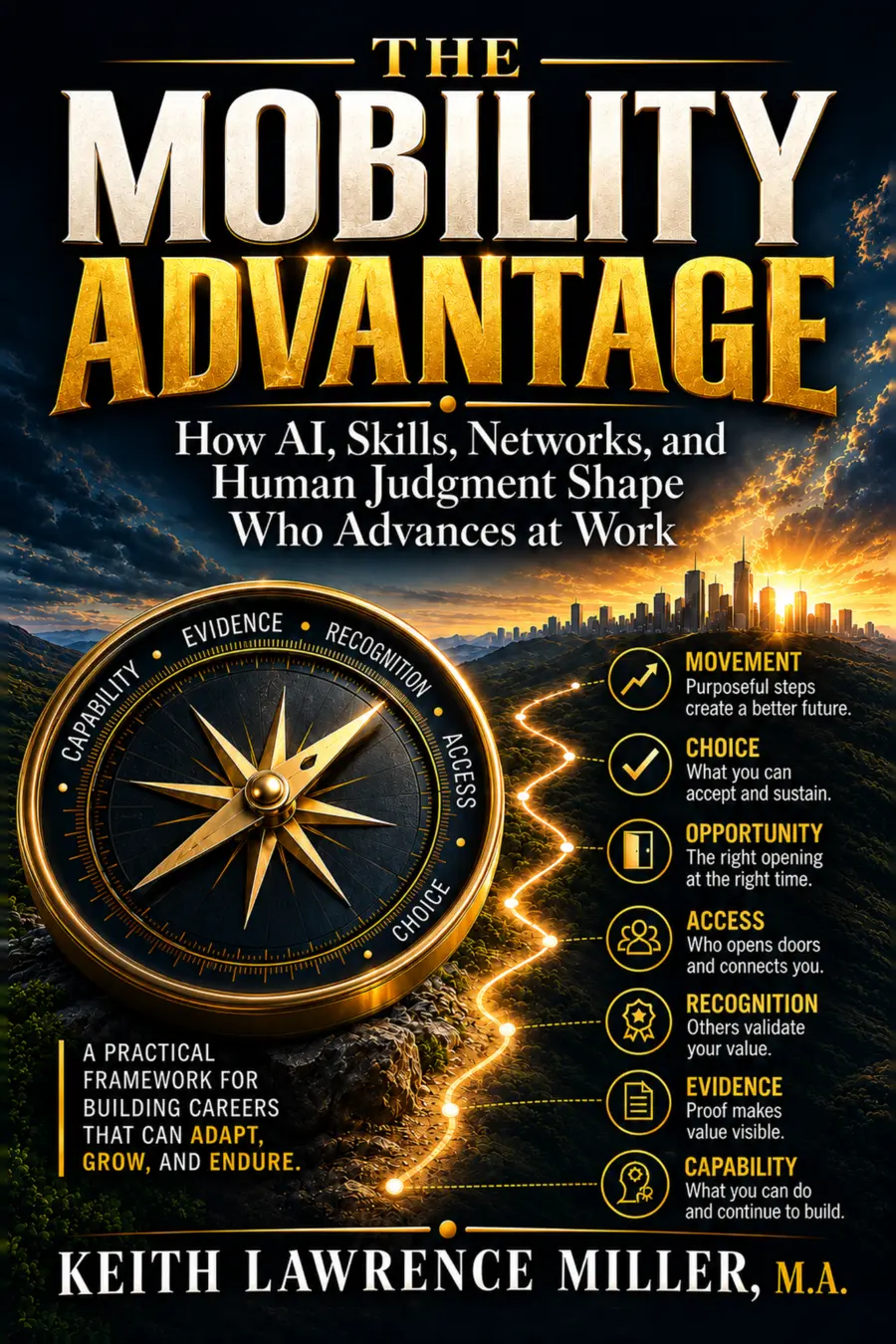
Continue the Idea
The Mobility Advantage
How AI, Skills, Networks, and Human Judgment Shape Who Advances at Work
The Mobility Advantage develops the complete Career-Conversion Model and includes practical tools such as the Career Mobility Index, Career Concentration Audit, Professional Evidence Bank, Relationship Portfolio, Reinvention Bridge, Annual Mobility Review, and Institutional Mobility Scorecard.
Explore The Mobility Advantage on AmazonCareer strategy and coaching
Ready to Examine Your Own Career Strategy?
Ivy League Coaching helps professionals move beyond résumé writing to examine career positioning, evidence, market recognition, target opportunities, professional narrative, and the strategy required to create greater career choice.