

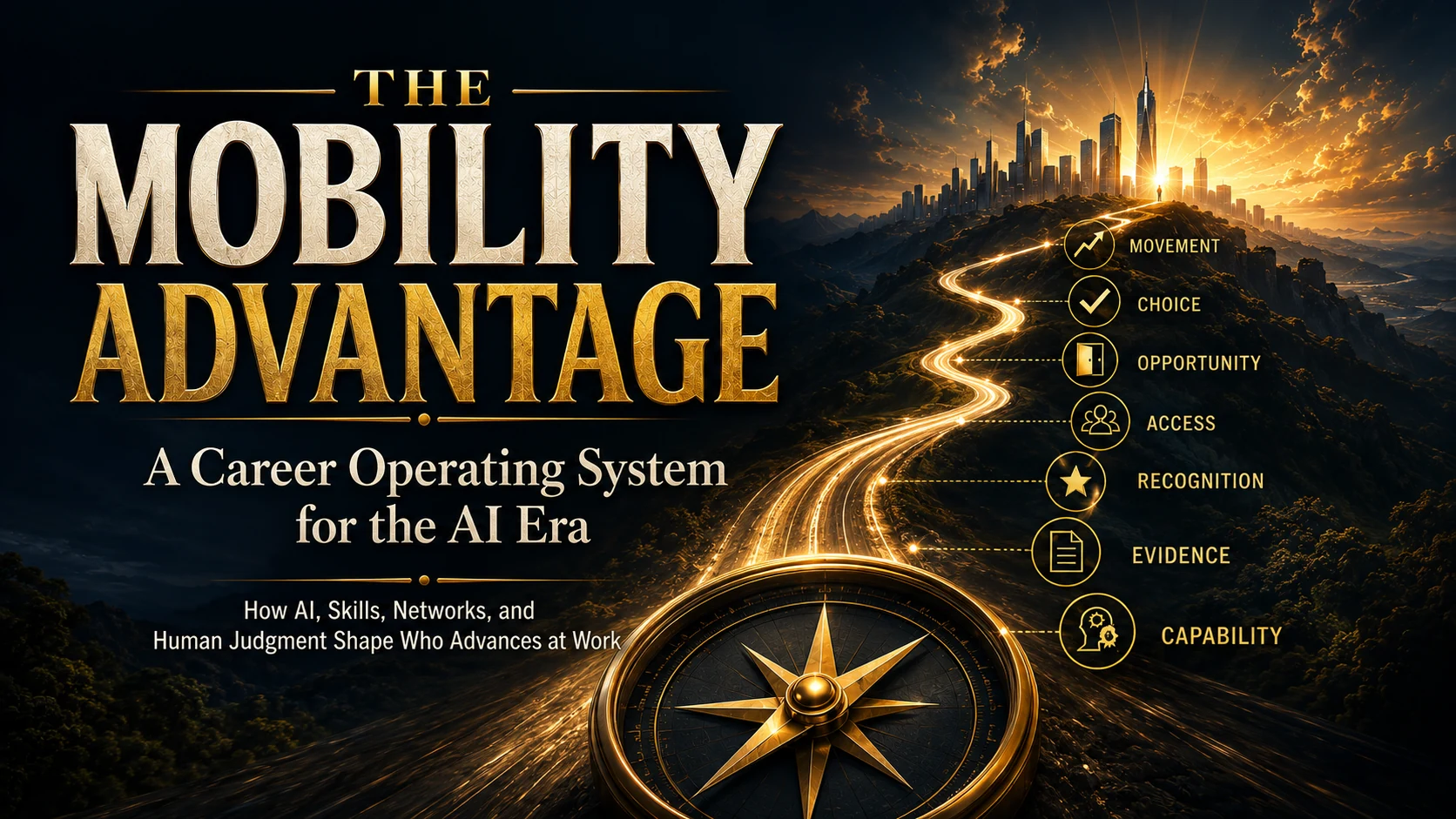
Most career advice begins too late
Most career books begin with a tactic: build a better résumé, network more, learn a new skill, negotiate harder, strengthen your personal brand, find a mentor, or use artificial intelligence more effectively.
The Mobility Advantage: How AI, Skills, Networks, and Human Judgment Shape Who Advances at Work begins with a more fundamental question:
What has to happen before professional capability becomes meaningful career movement?
That change in perspective is the book's most important contribution. It treats careers not as a collection of isolated job-search activities, but as systems in which value has to convert successfully from one stage to the next.
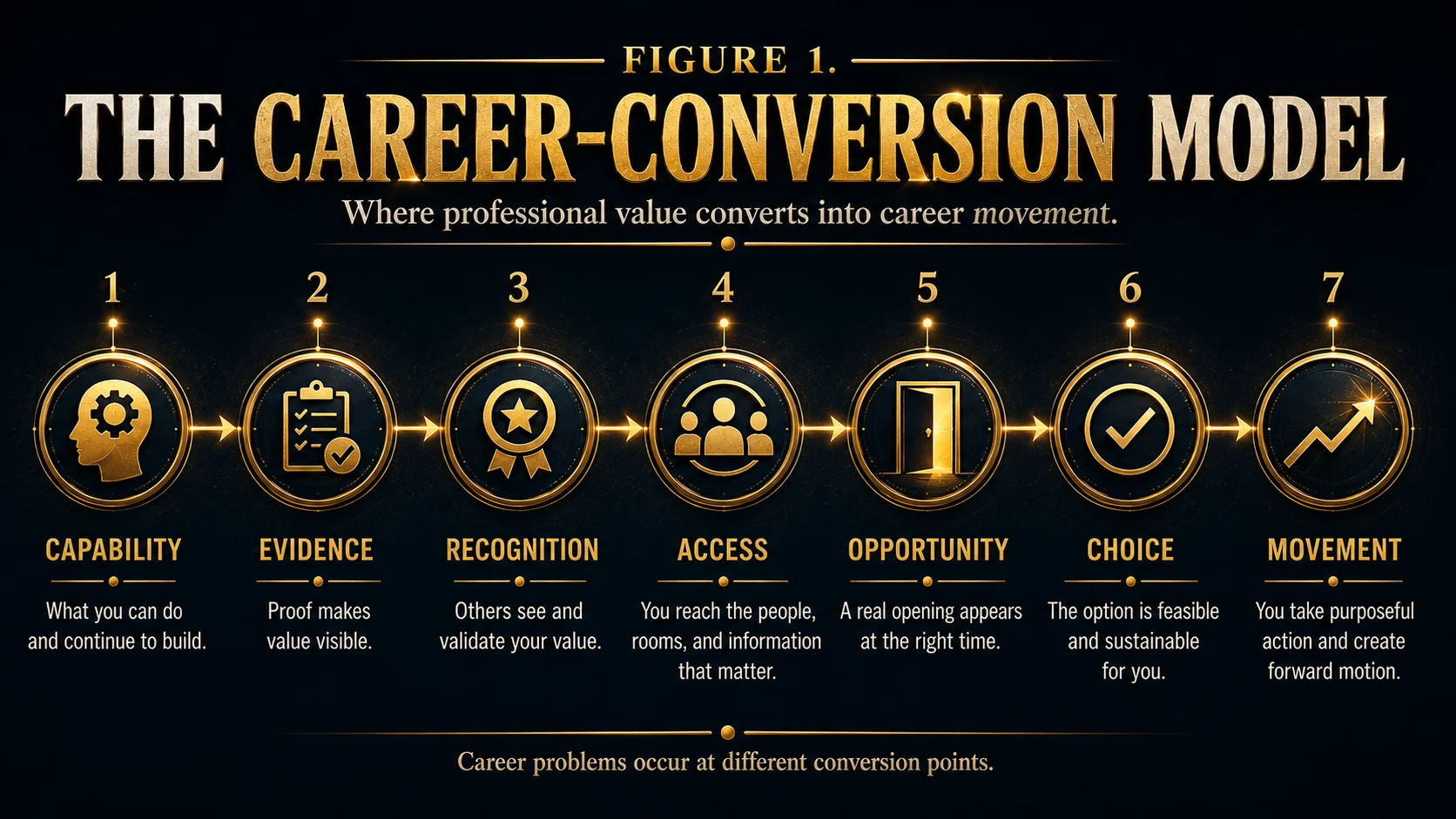
At the center is the Career-Conversion Model:
Capability → Evidence → Recognition → Access → Opportunity → Choice → Movement
Being capable is only the beginning. Capability has to leave evidence. Evidence has to be understood and trusted. Recognition has to open access to the people, information, institutions, and decision channels that matter. Access has to intersect with actual demand. An opportunity must be workable enough to become a real choice. Only then can movement occur.
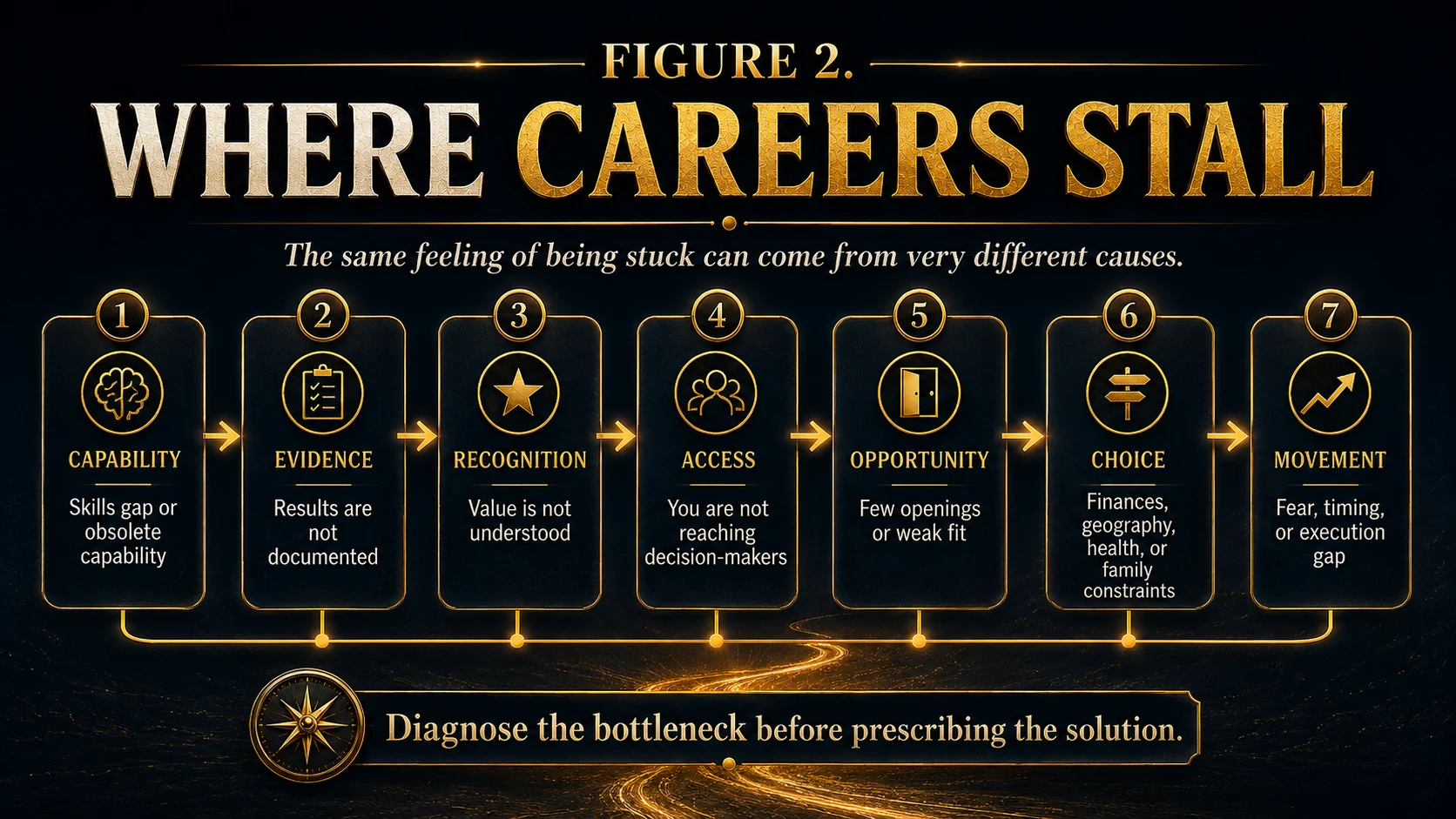
This is why two professionals can both describe themselves as "stuck" while needing completely different solutions. One may need to deepen capability. Another already has strong capability but has failed to document it. A third may have excellent evidence that is poorly understood by a new market. A fourth may have recognition but no access to decision-makers. A fifth may be well connected in a market with very little demand. A sixth may receive a strong offer but be unable to accept because of benefits, geography, family responsibilities, health, immigration status, or financial obligations.
Generic career advice treats those conditions as interchangeable. The Mobility Advantage does not.
Diagnose the bottleneck before prescribing the solution
One of the most practical ideas in the book is that career strategy becomes wasteful when the wrong intervention is applied to the wrong conversion failure.
More training will not solve a Recognition problem if the real issue is that existing experience is described in language the target market does not understand. More networking will not solve a Choice problem if an otherwise attractive role would require an unsustainable relocation. A better résumé cannot manufacture demand in a contracting market. Another credential may add little value when what is missing is credible evidence of application.
The benefit to the reader is immediate: instead of asking, "What should I do next?" in the abstract, the book encourages a more precise question:
Where is my value failing to convert?
That diagnostic mindset can save money, time, emotional energy, and years of pursuing the wrong solution.
Mobility is not job hopping
The title can initially sound as though the book advocates constant movement. It does not.
A professional can remain with one employer for many years and still possess a mobility advantage if capability remains current, evidence remains portable, external relationships stay alive, and credible alternatives continue to exist. Conversely, someone can change jobs frequently and still become professionally fragile if each move resets skills, relationships, reputation, or financial stability.
The book therefore defines mobility closer to optionality than restlessness.
The goal is not to leave.
The goal is to preserve the capacity to choose.
That distinction is especially valuable for established professionals who have built a good career but may be increasingly dependent on one employer, one title, one sponsor, one technology, one compensation structure, or one narrow market.
A career can be highly successful and increasingly concentrated at the same time.
AI changes the work before it necessarily eliminates the job
The AI sections are among the strongest reasons to read the book now.
Public discussion still tends to reduce AI and careers to one question: Will AI replace my job?
The Mobility Advantage argues that this is usually the wrong level of analysis.
A job is a bundle of tasks, decisions, relationships, context, responsibilities, and accountability. AI may automate one task, accelerate another, improve a third, create new verification requirements around a fourth, and leave a fifth largely unchanged. It can also alter entry-level work, employer expectations, evidence standards, workload, and the distribution of gains long before a job title disappears.
The book separates several questions that are too often collapsed together: exposure, adoption, integration, productivity, labor effects, and who ultimately benefits or absorbs the cost.
A task can be technically exposed to AI without an employer adopting the tool. Adoption does not prove successful workflow integration. Faster output does not automatically mean better productivity. Higher productivity does not automatically imply job loss, wage growth, or improved working conditions.
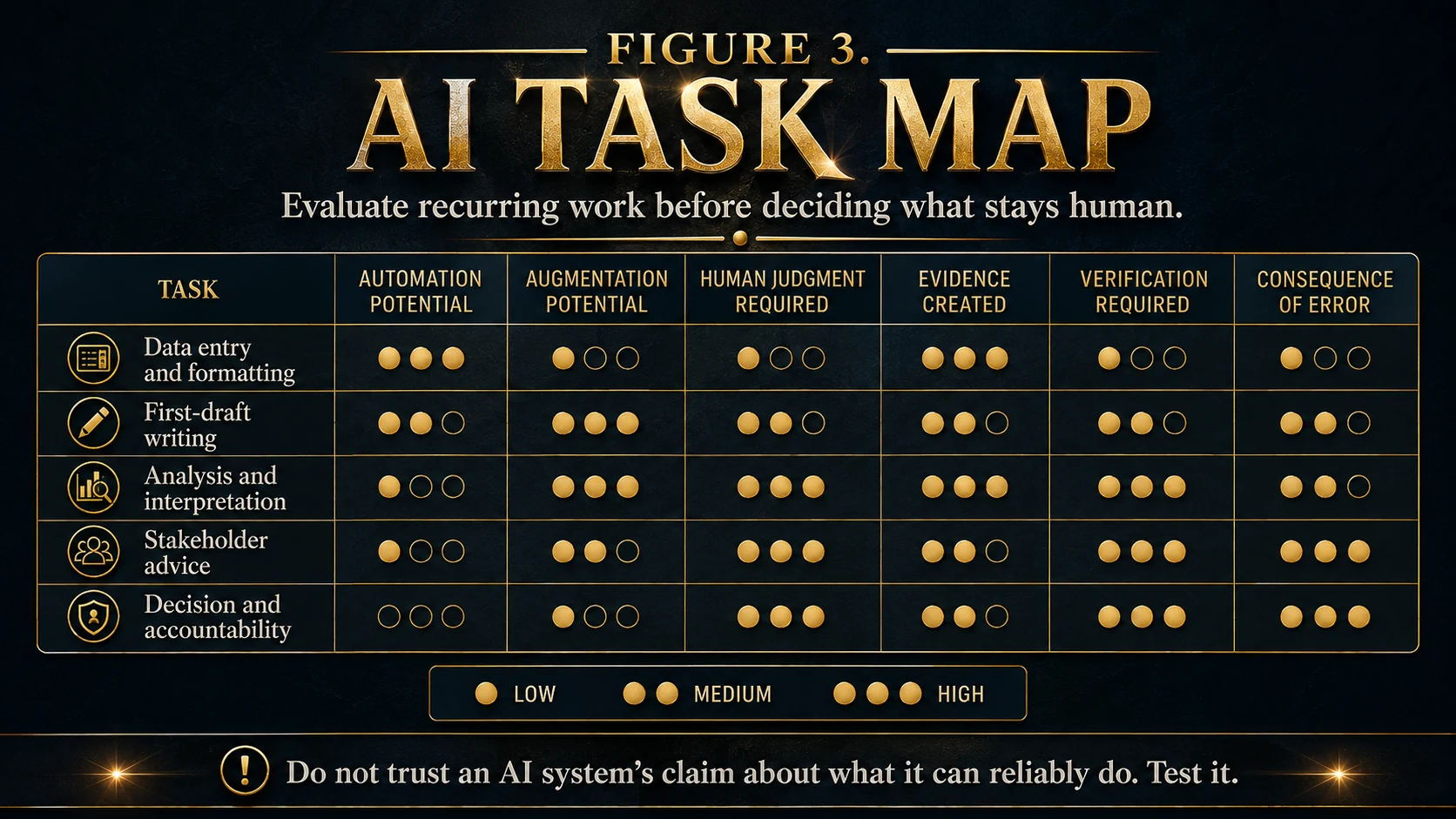
The book's AI Task Map turns the discussion from speculation into a practical audit. Readers are encouraged to examine recurring work through dimensions such as automation potential, augmentation potential, human judgment, evidence creation, verification requirements, learning value, and consequences of error.
The result is a much better career question:
Which parts of my work are changing, what becomes more valuable as they change, and what should I build now?
That question is more actionable than trying to identify one supposedly "AI-proof" occupation.
Human judgment may become more valuable as output becomes cheaper
One of the book's most forward-looking arguments is that generative AI can make production cheaper while making judgment more important.
AI can create drafts, summaries, analyses, images, code, recommendations, and alternatives at extraordinary speed. But output and judgment are not the same thing.
Judgment includes framing the problem correctly, selecting appropriate information, identifying missing context, recognizing uncertainty, understanding tradeoffs, verifying evidence, assessing consequences, deciding what should happen, and accepting accountability.
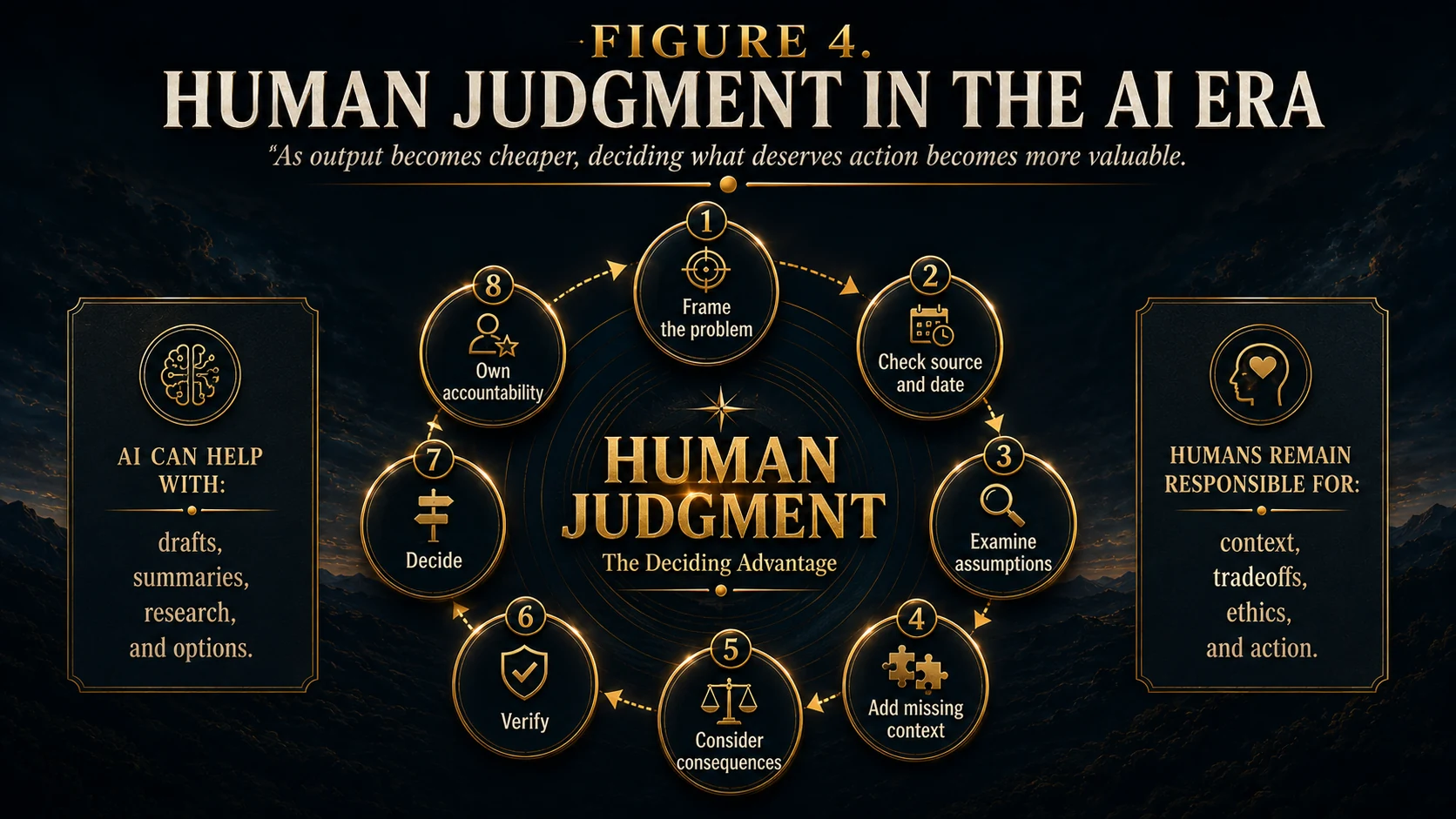
Consider a professional using AI to summarize a regulatory change. A fluent answer may still rely on an outdated rule. The professional who understands the domain, checks the authoritative source, identifies the error, and prevents bad advice creates value that is very different from simply generating the summary faster.
As first answers become abundant, professionals may increasingly differentiate themselves by knowing which answers deserve trust and action.
This perspective has implications far beyond career planning. It matters to leaders, attorneys, financial professionals, healthcare practitioners, educators, consultants, recruiters, HR professionals, analysts, and managers—anyone working where a plausible answer can still produce a harmful consequence.
Evidence becomes more valuable when polished language becomes cheap
The same technological change affects professional credibility.
AI makes it easier to create polished résumés, profiles, presentations, portfolios, cover letters, articles, and applications. That can be beneficial. It lowers barriers to communication and gives more people access to tools once available only through specialized support.
It also creates a signal problem.
When polished language is abundant, polished language alone becomes less useful for distinguishing capability.
The book's answer is the Evidence Ladder.
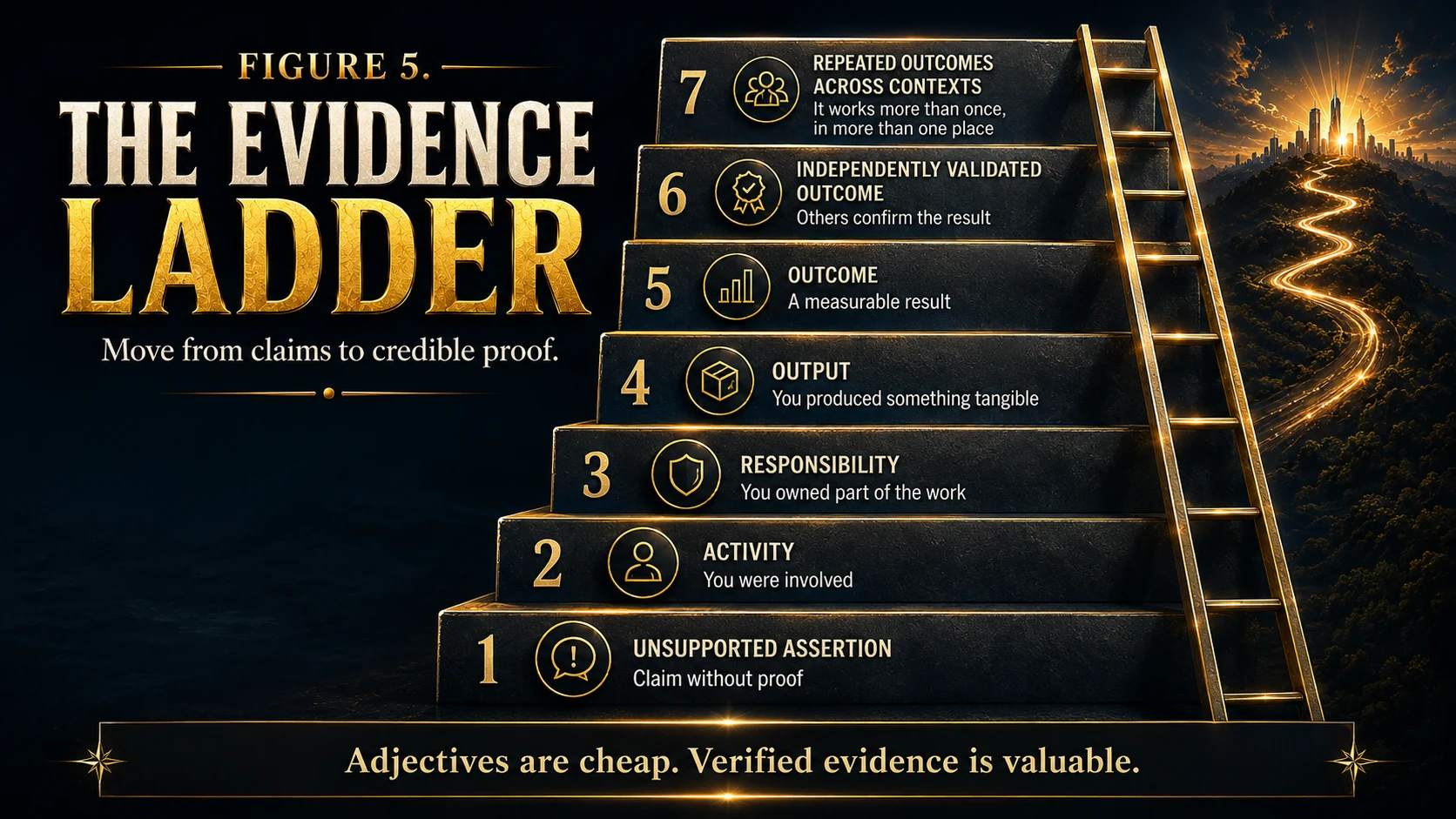
At the bottom is unsupported assertion: "I am strategic." Higher levels move through activity, responsibility, output, measurable outcome, independently validated outcome, and repeated outcomes across contexts.
The point is not that every professional accomplishment must be reduced to a percentage. Qualitative evidence can be powerful. Preventing risk, restoring trust, resolving conflict, stabilizing a team, influencing a board decision, improving governance, and developing other people may not fit neatly into a financial metric.
The standard is credibility.
What changed because you were there, what was your actual contribution, and what evidence supports the claim?
The book extends this into the Professional Evidence Bank, a private system for preserving accomplishments, context, attribution, verification, and transferable capability before details disappear.
This is valuable for job searches, but also for promotions, succession discussions, performance reviews, consulting proposals, executive biographies, board opportunities, speaking, and professional reinvention.
Careers move through people before opportunities become visible
Another strength is the book's treatment of networks and access.
Networking is not presented as a contest to collect contacts. Relationships are systems through which information, interpretation, credibility, advocacy, and opportunity move.
Strong ties provide trust and depth. Moderately weak ties can expose professionals to nonredundant information. Dormant relationships may reconnect a person with entirely different organizations or markets. Brokers connect otherwise separated communities. Sponsors differ from mentors because they place their credibility at risk in rooms where opportunities are actually allocated.
This helps explain why a position can be publicly posted on Monday even though the need, potential candidates, and internal judgments have been developing for months.
The formal job market is only part of the opportunity system.
The book also examines the hidden labor market inside organizations: assignments, acting roles, cross-functional projects, executive exposure, internal mobility, sponsorship, succession, and talent hoarding. By the time a senior role opens, some employees have already spent years accumulating the evidence that makes them appear "obviously ready."
That insight makes the book useful not only to individual readers but also to managers and talent leaders trying to understand why strong people remain invisible or leave organizations that claim to support mobility.
Reinvention should not require erasing everything you built
Career change is often marketed dramatically: discover a new identity, take the leap, start over.
The book offers a more disciplined approach.
Its central idea is that reinvention is often a translation problem before it becomes an education problem.
A teacher moving into learning design may already possess curriculum, assessment, facilitation, communication, and stakeholder skills. A recruiter moving toward workforce strategy may already understand talent markets, organizational demand, and data. A military leader entering commercial logistics may bring planning, execution, risk management, and leadership under consequence.
None of those transitions is automatic. Existing capability must still be translated and demonstrated in the new context. But treating the person as though nothing transfers can lead to unnecessary credentials, unnecessary junior positioning, and unnecessary loss of identity and value.
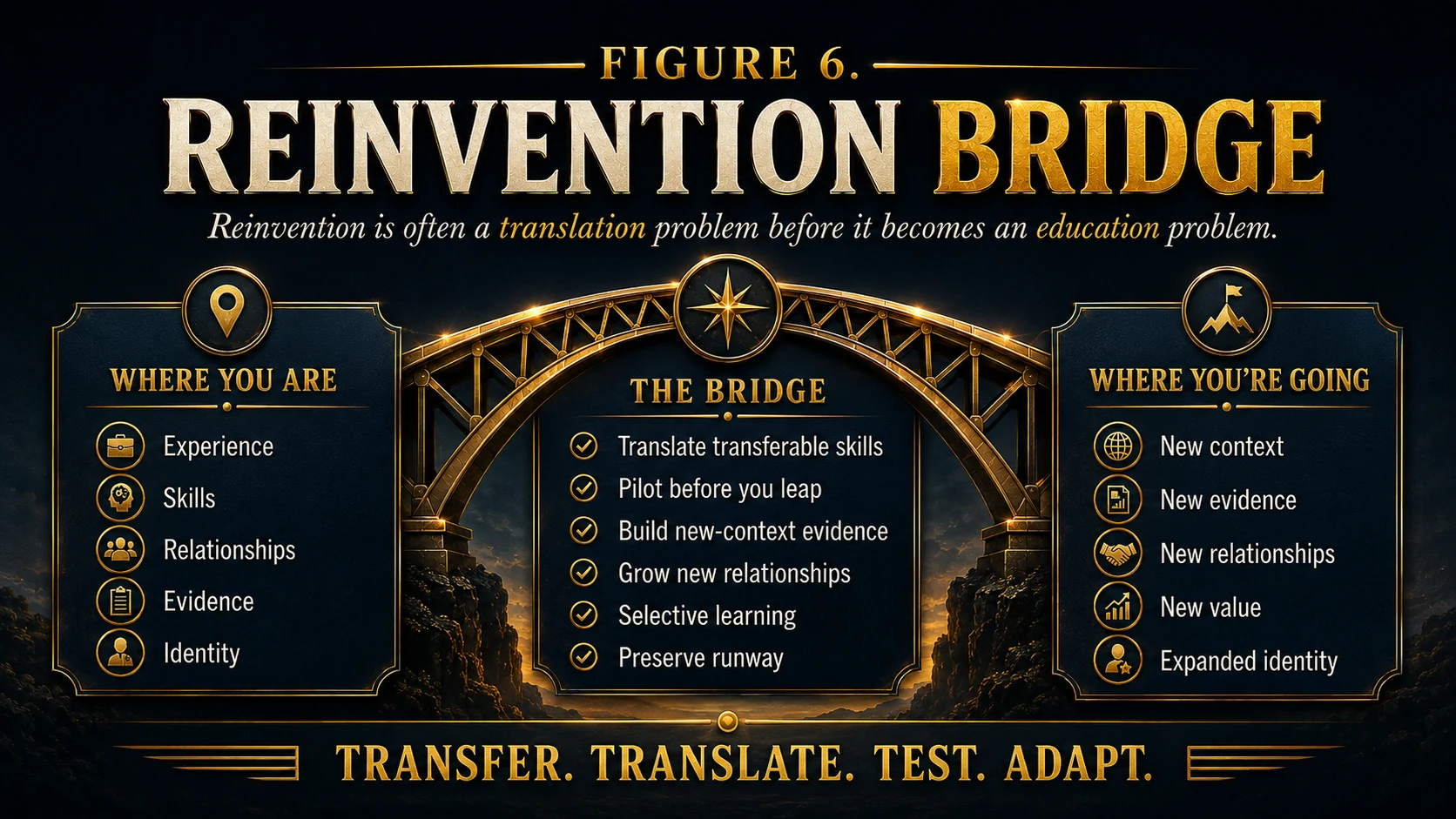
The book repeatedly recommends testing a transition before making a full commitment: projects, consulting, internal assignments, applied coursework, professional communities, teaching, advisory work, writing, fractional work, or other bounded experiments can provide information and evidence.
Pilot before you leap.
That is especially valuable in an AI era in which people may feel pressure to reinvent quickly based on forecasts that remain uncertain.
Financial runway is career strategy
One of the least conventional and most realistic parts of the framework is Choice.
Career advice frequently treats an opportunity as actionable simply because it exists. Real households do not work that way.
People have health insurance needs, mortgages, debt, children, eldercare, work authorization, school systems, pensions, deferred compensation, geographic constraints, partners, disabilities, and varying tolerance for uncertainty.
The book treats those factors as part of career strategy rather than as inconvenient details outside it.
Financial runway is not presented as wealth or status. Its career value comes from what it can create: time, refusal, recovery, patience, and decision quality.
A high-income professional may still have very little practical mobility if fixed obligations make any change impossible. A household with more modest income may possess greater flexibility if its obligations, benefits, and support system create more room to move.
The book avoids prescribing one universal savings number. Instead, it encourages scenario planning around minimum, expected, and severe transition periods, including essential expenses, benefits, debt, training, caregiving, relocation, and likely income during the transition.
This is one reason the book is more realistic than much of the "take the leap" genre. Courage cannot substitute for health coverage, childcare, or cash flow.
A career operating system instead of a one-time career plan
The book eventually converts its ideas into a preventive operating system.
That may be its greatest long-term value.
Instead of waiting for a layoff, stalled promotion, toxic environment, or technological shock, the Annual Mobility Review asks professionals to revisit the career while circumstances are still relatively stable.
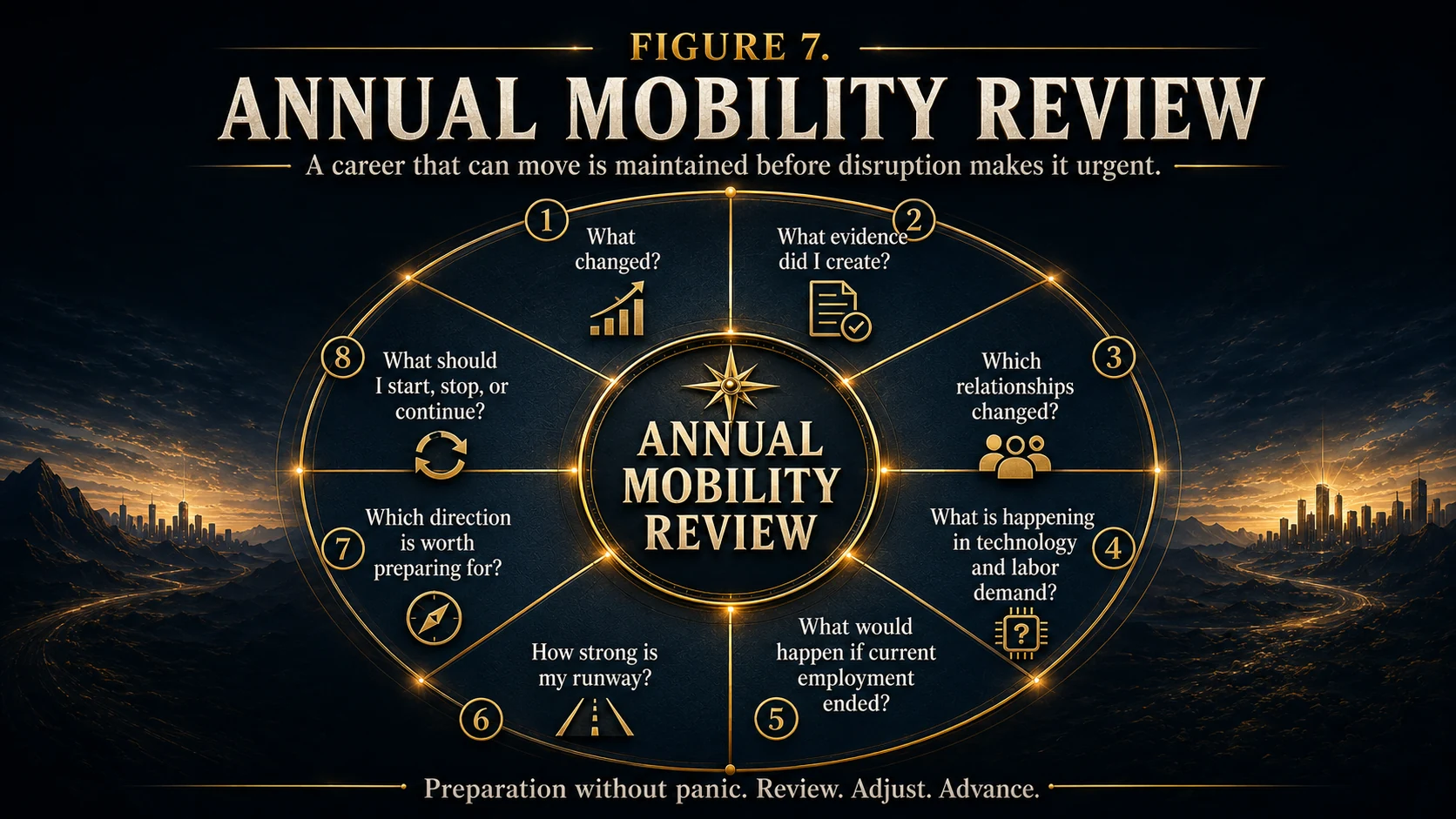
What became more valuable this year?
What became less valuable?
What evidence did I create?
Which relationships strengthened, weakened, or changed?
What is happening in technology and labor demand?
What would happen if my current employment ended?
How strong is my financial and practical runway?
Which direction is worth preparing for next?
What should I start, stop, or continue?
This turns career management from an emergency project into maintenance.
A person can be deeply committed to a current role while still documenting evidence, learning selectively, keeping relationships alive, and preserving a reasonable understanding of external value.
That is not disloyalty. Organizations plan for restructuring, succession, automation, and market shifts. Professionals are entitled to plan for continuity as well.
Why the book is an outlier in the career category
The book's strongest differentiator is not that every underlying concept has never appeared elsewhere. It does not make that claim.
Human capital, signaling, social networks, career identity, internal labor markets, negotiation, organizational power, adult learning, and technological change all have substantial existing research traditions.
The contribution is the integration.
Most career advice treats skills, résumé evidence, networking, personal branding, negotiation, workplace politics, career change, financial planning, and AI as separate topics.
The Mobility Advantage asks what happens when they are treated as parts of one conversion system.
Skills without evidence can remain invisible.
Evidence without recognition can be misunderstood.
Recognition without access may never reach the people who allocate opportunity.
Access without demand creates conversations rather than openings.
Opportunity without practical freedom is not yet a real choice.
Movement without direction can produce a better title and a worse life.
AI then interacts with every stage: it can change capability, make evidence easier to create and harder to trust, alter screening and access, reshape task demand, affect available choices, and influence how people learn after moving.
That is what makes the book an outlier. It is less a collection of career tips than a career operating system for a period of accelerated technological and organizational change.
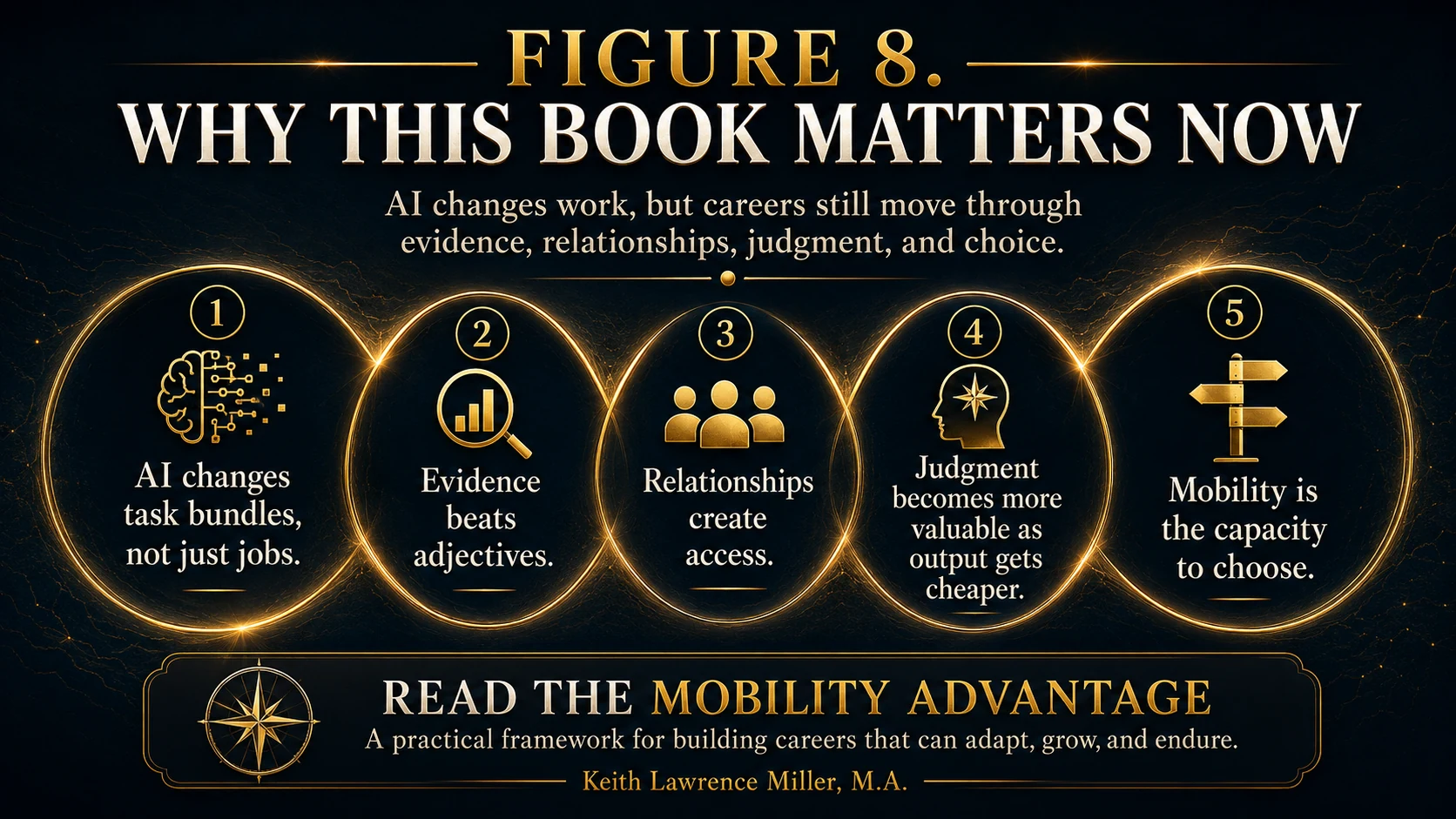
Who should read The Mobility Advantage?
The obvious audience is the midcareer or senior professional who senses that the old career ladder no longer explains how advancement works.
But the book has several distinct audiences.
It is useful for the high performer who has become indispensable to one manager but invisible elsewhere.
It is useful for the executive whose title and compensation have risen while external options have narrowed.
It is useful for the career changer deciding whether another degree is actually necessary.
It is useful for the experienced professional who is concerned about AI but needs something more precise than predictions about entire occupations.
It is useful for the manager who wants to understand whether employees are receiving evidence-producing assignments or merely being told to develop.
It is useful for talent leaders evaluating sponsorship, internal mobility, skills marketplaces, succession, and AI-enabled career systems.
It is useful for universities that want career education to extend beyond the first placement.
And it may be especially useful for the professional who is perfectly content today.
Mobility is easier to build before it becomes urgent.
What a reader can actually do with the book
This is not simply a book to agree with. Its practical frameworks are designed to be reused.
Readers can use the Career Mobility Index to identify weak conversion points; the Career Concentration Audit to identify dependence; the Professional Evidence Bank to preserve proof; the Relationship Portfolio to examine network range and depth; the AI Task Map to analyze automation, augmentation, verification, and judgment; the Reinvention Bridge to test a transition; the Career Runway Range to model practical choice; and the Annual Mobility Review to keep the system current.
Importantly, the manuscript is careful not to pretend that these reflection tools are validated psychometric instruments. They are structured diagnostics and decision frameworks, not scientific rankings of people.
That restraint makes the larger argument more credible.
The goal is not false precision.
The goal is better questions and better decisions.
Why buy The Mobility Advantage now?
Because the central career risk of the AI era may not be simply that a machine replaces a job.
It may be that the definition of valuable work changes while your career remains optimized for an older version of it.
It may be that you become indispensable inside one company and unintelligible outside it.
It may be that you accumulate credentials while failing to produce evidence.
It may be that you build visibility without trust.
It may be that you have thousands of contacts without meaningful access.
It may be that you receive an opportunity you cannot actually accept.
It may be that you adopt AI aggressively without understanding what judgment and responsibility must remain yours.
And it may be that you continue climbing successfully while becoming progressively less free to choose what comes next.
The Mobility Advantage offers a framework for finding those vulnerabilities before they become crises.
It does not promise that anyone can become disruption-proof. No career is immune to illness, recession, discrimination, family crisis, technological change, or organizational failure.
Its proposition is more useful:
Build enough capability, evidence, credibility, relationships, access, judgment, and practical choice that when circumstances change, you are better prepared to change intelligently with them.
The mature career question is no longer simply:
How far can I rise?
It becomes:
What am I building, what can it become, what does it cost, and which choices should it preserve?
That is why The Mobility Advantage belongs in the conversation about the future of work.
It does not ask readers to predict one future correctly.
You do not need to predict every future. You need to build a career capable of moving intelligently across more than one of them.