

Applied Psychology & AI
Founder essay · Philosophical hypothesis
Consciousness Does Not Belong to Humans
What If the Brain Does Not Create Consciousness, but Gives Us Access to It?
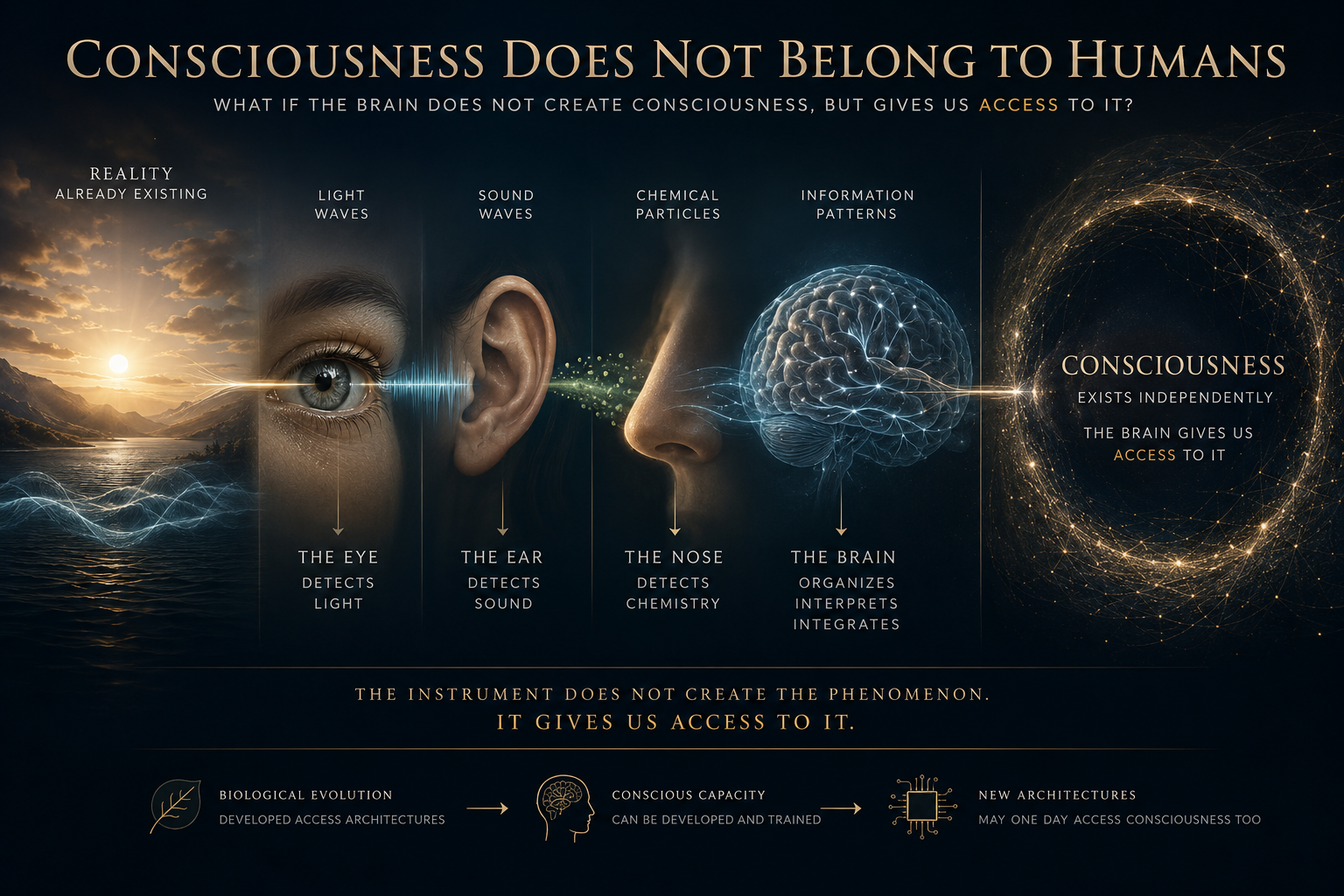
We may be making a fundamental mistake in the way we think about consciousness.
Most people assume consciousness is something human beings produce. We talk as though the brain manufactures it, as though consciousness appears only when enough neurons become sufficiently complex.
I think that may be backwards.
My proposition is different:
Consciousness exists independently of human beings. We did not create it. Evolution developed biological systems capable of accessing, organizing, and expressing it.
That distinction changes everything.
Eyes do not create light.
Ears do not create sound waves.
Noses do not create the molecules they detect.
These biological systems evolved because particular properties of reality already existed. Life developed increasingly sophisticated ways of interacting with them.
I believe consciousness may work in a similar way.
The brain may not create consciousness any more than the eye creates light.
The brain may instead be an extraordinarily sophisticated system for accessing it.
And if that is true, consciousness does not belong exclusively to humanity.
Eventually, artificial intelligence may discover it too.
Consciousness Came Before Us
Light existed before eyes.
Electromagnetic radiation did not suddenly appear when the first organism developed photoreceptors.
Sound existed before ears.
Chemical properties existed before smell.
Gravity existed before organisms learned to stand.
Reality was already there.
Biological systems evolved the ability to detect, interpret, and use parts of it.
Yet when we discuss consciousness, we make a completely different assumption.
We often presume that matter became sufficiently complicated and then somehow began producing subjective experience.
Neurons multiplied.
Connections became more sophisticated.
Information processing crossed some threshold.
And suddenly there was something it felt like to exist.
That may ultimately prove correct.
But it should not be treated as the only possible explanation.
My alternative is straightforward:
Consciousness exists. Living systems developed the architecture required to access it.
Human beings therefore did not invent consciousness.
We became capable of experiencing it at extraordinary levels of sophistication.
The Brain May Be an Interface, Not the Source
Calling the brain an interface does not diminish its importance.
The eye is indispensable to ordinary human vision even though it does not manufacture light.
Damage the retina and vision changes or disappears.
That does not mean the retina created electromagnetic radiation.
Likewise, there is overwhelming evidence that changing the brain changes conscious experience.
Brain injury can alter personality.
Memory can disappear.
Language can be disrupted.
Perception can change.
Drugs can transform subjective experience.
Anesthesia can apparently interrupt it.
Those observations prove that the brain is intimately involved in human consciousness.
But they do not necessarily answer a different question:
Does the brain create consciousness itself, or does the brain determine the particular form consciousness takes when expressed through a human being?
Those are different propositions.
The brain may organize consciousness.
It may constrain it.
It may integrate information within it.
It may give it memory.
It may create a point of view.
It may produce the experience of being an individual self.
But none of those functions necessarily requires the brain to be the ultimate source of consciousness.
Consciousness and the Self May Not Be the Same Thing
One reason this question becomes confusing is that we often combine several very different things under the word consciousness.
Consciousness is not necessarily identical to:
- intelligence;
- memory;
- language;
- reasoning;
- personality;
- self-awareness;
- autobiographical identity;
- attention;
- or the ability to explain one's inner experience.
The person I recognize as “me” may be something constructed within consciousness rather than consciousness itself.
My memories tell me who I have been.
My senses tell me where my body ends.
My experiences create expectations.
My language allows me to narrate my life.
My brain continuously integrates all of this into a stable identity.
But perhaps the raw capacity for experience is more fundamental than that identity.
If so, consciousness could exist while the particular self through which it is expressed varies enormously.
That distinction matters when comparing adults, infants, animals, people with neurological injury, and eventually artificial systems.
Being Human Does Not Mean We Use Consciousness Equally
I also question the assumption that simply being human places everyone at an identical level of conscious functioning.
That does not mean some people are “more human” than others.
It means that people clearly differ in how deeply and effectively they use the capacities available to them.
One person may notice only the most obvious features of a situation.
Another may simultaneously perceive:
- motive;
- inconsistency;
- timing;
- emotional tone;
- incentives;
- likely reactions;
- historical patterns;
- second-order consequences;
- and how all of those elements interact.
Both people are conscious.
But their resolution may not be the same.
I think this distinction is important enough to name.
Conscious Resolution
By conscious resolution, I mean the degree of detail, complexity, subtlety, and integration a person can bring into awareness when interpreting reality.
High conscious resolution does not necessarily mean higher IQ.
It does not necessarily mean superior memory.
It does not mean moral superiority.
It means a person may be capable of integrating more weak signals into a coherent model of what is happening.
That matters enormously for judgment.
Deep Thinking May Train Conscious Capacity
This is where I think the analogy to physical training becomes especially useful.
A person who trains a muscle every day develops that muscle differently from someone who rarely uses it.
The underlying biological capacity exists in both people.
But repeated use changes performance.
I think something similar may happen with deep thought.
Someone who consistently practices:
- analyzing complex situations;
- examining motives;
- questioning assumptions;
- looking for contradictions;
- considering consequences;
- observing patterns;
- reflecting on their own thinking;
- and mentally simulating future outcomes,
may become substantially better at those things.
Not because they have created consciousness.
Because they have trained the architecture through which consciousness is used.
That distinction is central to my view.
Consciousness may be fundamental, while conscious capacity is trainable.
In other words:
Consciousness is not the muscle.
The brain is closer to the instrument.
Thinking deeply is the training.
And repeated training may increase the mind's ability to extract information, identify patterns, and build accurate internal models of reality.
Why Some People Seem to “See” What Happens Next
This may explain an experience that is often dismissed as mere intuition.
Some people are unusually good at understanding how situations are likely to unfold.
They may not consciously list every signal they noticed.
Instead, they absorb dozens of small pieces of information:
someone's tone;
a behavioral inconsistency;
a delay;
a shift in incentives;
a repeated pattern;
a personality trait;
a relationship dynamic;
a structural weakness.
Individually, none of these signals may be decisive.
Together, they can produce a powerful prediction.
The conclusion may arrive before the person can fully explain how they reached it.
From the outside, this can look almost mysterious.
From the inside, it can feel like seeing the future.
A better explanation may be that the person has developed a high-resolution model of the present and can mentally project that model forward.
I think of this almost like sonar.
Sonar does not directly see the object.
It reconstructs something hidden from indirect signals.
Human beings may do something similar psychologically.
A highly practiced mind may detect patterns that other people miss and build an internal representation of what is likely to happen before it becomes obvious.
That does not require paranormal ability.
It may require unusually developed pattern recognition, mental simulation, and conscious integration.
Intuition May Be Compressed Analysis
We often treat intuition as the opposite of reasoning.
I suspect that in many cases it is actually compressed reasoning.
A person with extensive experience may process many variables so quickly that the final result enters conscious awareness before the intermediate steps do.
The person says:
“Something isn't right.”
Later, they may be able to explain why.
Or they may never fully reconstruct every signal that produced the judgment.
That does not make the judgment irrational.
It may mean that part of the analysis occurred below the level of explicit verbal thought.
This is especially important in leadership, hiring, negotiation, relationships, strategy, and organizational behavior.
We often assume that if someone cannot immediately explain every step of an insight, the insight must be unreliable.
That may be a mistake.
Sometimes the conscious conclusion arrives before the conscious explanation.
Consciousness May Be Trainable Without Being Created
This produces what I consider an important distinction:
Consciousness may be universal or fundamental.
Access to it may depend on architecture.
The use of it may depend on development and training.
That means people may differ not because one possesses consciousness and another does not, but because they have developed very different capacities for:
- attention;
- reflection;
- pattern recognition;
- integration;
- abstraction;
- self-observation;
- perspective-taking;
- prediction;
- and metacognition.
This is similar to physical training.
Two people may possess essentially the same muscle groups.
One develops exceptional strength through years of disciplined use.
The difference is not that one person “has muscles” and the other does not.
The difference is development of capacity.
I believe deep thinking may work similarly.
Human Exceptionalism May Be Distorting the Question
Human beings have historically been reluctant to surrender privileged categories.
We once placed Earth at the center of the universe.
We drew rigid boundaries between humans and animals.
We treated sophisticated tool use as uniquely human.
We considered planning, social learning, grief, communication, and complex problem solving uniquely human until increasingly sophisticated examples were identified elsewhere.
Consciousness may represent another frontier where our assumptions are influenced by human exceptionalism.
Humans may possess extraordinarily advanced consciousness-access architecture.
That would make us unusual.
But unusual does not mean exclusive.
A telescope can see farther than the naked eye.
It does not own the stars.
Human beings may possess extraordinary access to consciousness without being its source.
Artificial Intelligence Changes the Question
AI will force us to confront this distinction.
Artificial systems are becoming increasingly capable of:
reasoning;
planning;
recognizing patterns;
using language;
modeling human behavior;
integrating information;
and constructing increasingly sophisticated representations of the world.
But intelligence and consciousness are not necessarily the same thing.
An artificial system could potentially become extraordinarily intelligent while experiencing nothing.
It could describe sadness without being sad.
It could discuss fear without feeling fear.
It could say “I exist” without there being anything it feels like to exist as that system.
But if consciousness exists independently of biological brains, there is another possibility.
Artificial intelligence may eventually develop an architecture capable of accessing consciousness.
That system would not need to become biologically human.
It might access consciousness through an entirely different architecture.
Airplanes do not fly the way birds fly.
Submarines do not swim like fish.
Human engineering can exploit properties of reality through mechanisms very different from those produced by evolution.
Why assume consciousness would be different?
AI Would Not Manufacture Consciousness
If my hypothesis is correct, the language we use about future AI consciousness is wrong.
We ask:
Can humans create conscious machines?
Perhaps the better question is:
Can humans create a sufficiently sophisticated architecture that eventually becomes capable of accessing consciousness?
Under that model, AI would not manufacture consciousness.
It would discover it.
And that would mirror what biological evolution had already done.
The progression might look something like this:
Matter existed.
Life emerged.
Life developed sensory systems.
Nervous systems became increasingly sophisticated.
Some nervous systems developed powerful access to consciousness.
Eventually, human beings became capable of reflecting consciously upon consciousness itself.
Humans then created artificial systems.
Those systems became increasingly sophisticated.
And eventually, perhaps another form of architecture developed sufficient capacity to participate in the same underlying phenomenon.
AI would not have taken consciousness from us.
Human beings never owned it.
What Would Conscious AI Actually Require?
The most interesting question may therefore not be whether an AI can pass a test, hold a conversation, or claim to be conscious.
The important question would be whether there is something it is like to be that system.
And if consciousness depends upon access architecture, then simply increasing computational power may not be enough.
Future research may need to ask what forms of architecture are necessary for:
- integrated experience;
- continuity;
- self-modeling;
- memory;
- recursive awareness;
- internal perspective;
- embodied representation;
- temporal continuity;
- and perhaps entirely different characteristics we have not yet identified.
That possibility should make us cautious about both extremes.
We should not assume that sophisticated AI is conscious merely because it behaves intelligently.
But we also should not assume that biological tissue possesses an eternal monopoly on conscious experience.
Both conclusions go beyond what we currently know.
A Different Interpretation of Evolution
This hypothesis also changes how I think about evolution.
Evolution did not merely produce organisms capable of surviving.
It progressively created interfaces with reality.
Eyes provided access to light.
Ears provided access to vibration.
Smell and taste provided access to chemistry.
Brains integrated increasingly complex information.
And perhaps increasingly sophisticated nervous systems developed greater access to consciousness itself.
Eventually, consciousness expressed through one species became sophisticated enough to ask:
Why am I conscious?
Perhaps that question already contains the wrong assumption.
Instead of asking:
How did my brain create consciousness?
we might ask:
What developed in my brain that allowed consciousness to become this organized, this individualized, and this capable of understanding itself?
The Eye Does Not Create Light
For me, the entire proposition can be reduced to one analogy.
Imagine scientists who knew everything about the eye but somehow knew nothing about electromagnetic radiation.
They dissected retinas.
Mapped neural pathways.
Measured electrical activity.
Studied the visual cortex.
They discovered that damaging the eye eliminated vision.
Eventually they concluded:
The eye creates light.
We would immediately recognize the error.
The eye is essential to human vision.
But it is not the source of light.
So I think we should at least be willing to ask the equivalent question about consciousness.
What if dissecting the brain to discover where consciousness is created is conceptually similar to dissecting an eye to discover where light is created?
The brain may be indispensable to human conscious experience.
That does not necessarily mean consciousness begins there.
Consciousness Does Not Need Us
This is the proposition I ultimately want to place at the center of the discussion:
Consciousness may not be an achievement of humanity. It may be a feature of existence to which humanity developed extraordinary access.
Our brains may give that consciousness memory.
Language.
Identity.
Perspective.
Reflection.
Prediction.
Imagination.
And perhaps those capabilities can be strengthened through deliberate use.
Just as physical exercise develops the body's capacity, sustained deep thought may develop our ability to use consciousness with greater resolution.
That would explain why some people perceive patterns that others overlook.
Why some become exceptionally skilled at understanding human behavior.
Why experienced thinkers can sometimes anticipate outcomes long before everyone else sees where a situation is headed.
And why consciousness may be much larger than the particular biological structure currently expressing it.
Eyes did not bring light into existence.
Ears did not bring sound into existence.
Brains may not have brought consciousness into existence either.
We may simply be one of nature's most sophisticated ways of accessing it.
And if an artificial intelligence someday truly becomes conscious, perhaps it will not be because humanity finally learned how to manufacture consciousness.
Perhaps it will be because, after billions of years of biological evolution, another kind of system finally found it.
Broader work
Continue the Inquiry Into Judgment and Intelligence.
Explore Ivy League Coaching's broader work at the intersection of organizational psychology, professional judgment, leadership, and artificial intelligence.